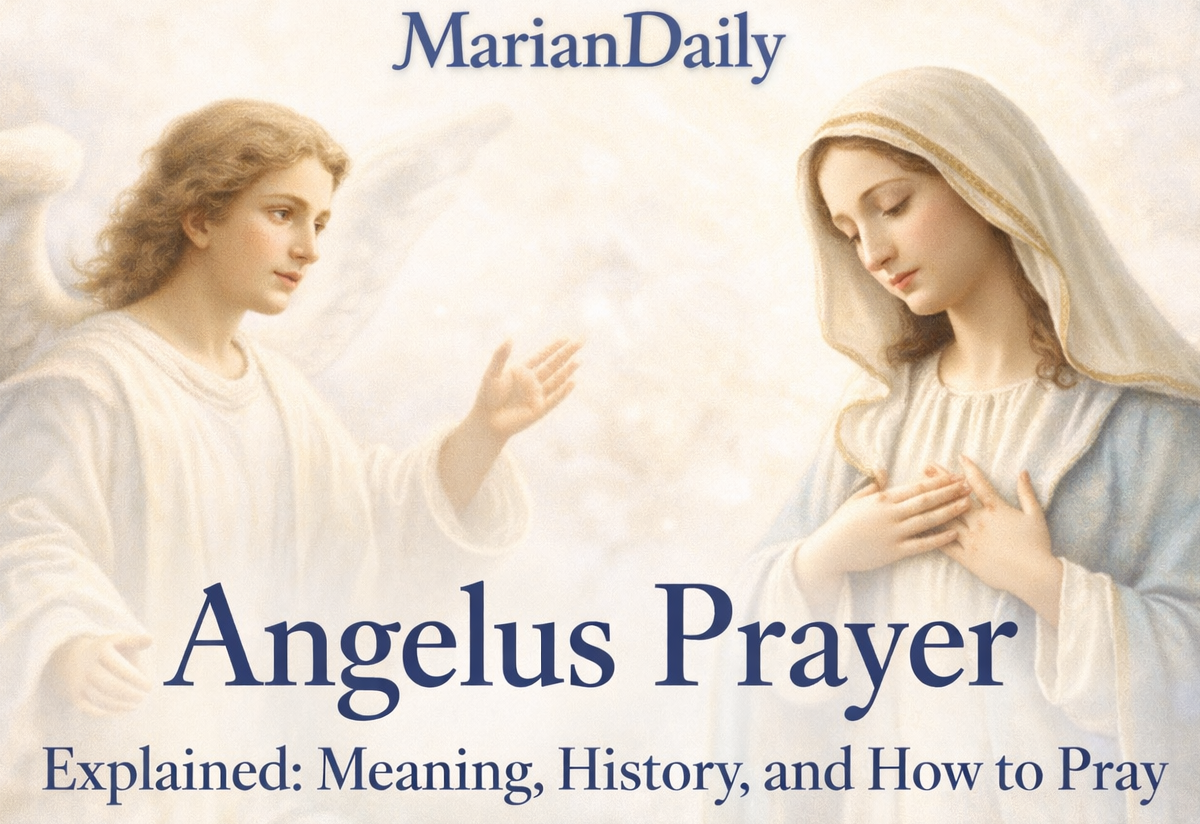
The Angelus is one of the most beautiful and traditional prayers in the Catholic Church. For centuries, Catholics have prayed the Angelus to remember the mystery of the Incarnation when the Son of God became man through the Virgin Mary.
This simple yet profound devotion invites believers to pause during the day and reflect on the moment when the angel Gabriel announced to Mary that she would become the Mother of Jesus. Through this prayer, Catholics honor the Blessed Virgin Mary and give thanks for the mystery of Christ’s coming into the world.
The Angelus is traditionally prayed three times a day—morning, noon, and evening. Each time it is prayed, believers are reminded of the humility of Mary, the power of God’s grace, and the great mystery of the Word becoming flesh.
Even today, the Angelus continues to unite Catholics around the world in prayer, reflection, and devotion.
What Is the Angelus Prayer?
The Angelus is a short Catholic devotion that commemorates the Annunciation, when the angel Gabriel announced to Mary that she would conceive Jesus by the power of the Holy Spirit.
The name “Angelus” comes from the first words of the prayer in Latin: Angelus Domini nuntiavit Mariae, which means “The Angel of the Lord declared unto Mary.”
This prayer is structured around three short verses and responses, each followed by a Hail Mary. At the end of the prayer, a concluding prayer reflects on the mystery of the Incarnation and asks for God’s grace.
Although the Angelus is brief, it carries deep spiritual meaning because it invites believers to remember the moment when God entered human history in the person of Jesus Christ.
The History of the Angelus
The Angelus prayer developed gradually in the life of the Church during the Middle Ages. It was originally connected with the ringing of church bells that called the faithful to pause and remember the Incarnation.
Over time, the custom of praying three Hail Marys became associated with this devotion. Eventually, the prayer took the form we know today, including the verses that reflect on the Annunciation.
By the fifteenth century, the Angelus was widely practiced throughout the Catholic world. Many churches rang bells at morning, noon, and evening to invite people to stop their daily work and pray.
Even today, the Angelus is prayed publicly in many places, including at the Vatican, where the Pope often leads the prayer with pilgrims gathered in Saint Peter’s Square.
When Catholics Pray the Angelus
The Angelus is traditionally prayed at three times during the day:
- Morning (around 6:00 AM)
- Noon (around 12:00 PM)
- Evening (around 6:00 PM)
These moments of prayer help believers pause during the day and remember God’s presence.
Praying the Angelus regularly helps Catholics keep their hearts focused on Christ and reminds them that ordinary daily life can be sanctified through prayer.
How to Pray the Angelus
The Angelus prayer consists of three short verses, each followed by a Hail Mary. After these prayers, a concluding prayer reflects on the mystery of the Incarnation.
The Angel of the Lord declared unto Mary
V. The Angel of the Lord declared unto Mary.
R. And she conceived of the Holy Spirit.
Hail Mary, full of grace,
the Lord is with thee.
Blessed art thou among women,
and blessed is the fruit of thy womb, Jesus.
Holy Mary, Mother of God,
pray for us sinners,
now and at the hour of our death.
Amen.
Behold the handmaid of the Lord
V. Behold the handmaid of the Lord.
R. Be it done unto me according to thy word.
Hail Mary, full of grace,
the Lord is with thee.
Blessed art thou among women,
and blessed is the fruit of thy womb, Jesus.
Holy Mary, Mother of God,
pray for us sinners,
now and at the hour of our death.
Amen.
And the Word was made flesh
V. And the Word was made flesh.
R. And dwelt among us.
Hail Mary, full of grace,
the Lord is with thee.
Blessed art thou among women,
and blessed is the fruit of thy womb, Jesus.
Holy Mary, Mother of God,
pray for us sinners,
now and at the hour of our death.
Amen.
Concluding Prayer
Let us pray.
Pour forth, we beseech thee, O Lord, thy grace into our hearts, that we to whom the Incarnation of Christ thy Son was made known by the message of an angel may, by his Passion and Cross, be brought to the glory of his Resurrection.
Through the same Christ our Lord.
Amen.
Why the Angelus Is a Powerful Devotion
The Angelus reminds believers of one of the most important moments in salvation history the Incarnation of Jesus Christ. Through Mary’s humble “yes,” God entered the world to bring salvation to humanity.
By praying the Angelus regularly, Catholics pause during the day to remember this mystery and place their lives under God’s grace.
This devotion also strengthens Marian devotion by honoring Mary’s obedience and faith. Her response to God’s call remains a powerful example for Christians everywhere.
Through the Angelus, believers unite prayer, reflection, and gratitude for the great gift of Jesus Christ.
A Simple Daily Devotion
The Angelus is a prayer that can easily become part of daily life. It only takes a few minutes to pray, yet it carries deep spiritual meaning.
Many Catholics choose to pray it:
- at the beginning of the day
- during a midday pause
- in the quiet of the evening
These moments of prayer help believers remember that God is present in every part of life.
By praying the Angelus faithfully, Catholics grow closer to Christ through the loving example of the Blessed Virgin Mary.
Related Articles
 Powerful Prayer to Our Lady of Lourdes for Healing and Strength
 The Sacred Heart of Jesus Devotion: Meaning, Promises, and Catholic Tradition
 How the Blessed Virgin Mary Teaches Us to Trust God Completely
 What Every Catholic Family Should Have in Their Home for Spiritual Growth
 How to Pray the Rosary Step-by-Step (Complete Catholic Guide)
 Finding Peace in Uncertain Times: A Catholic Reflection on God’s Providence