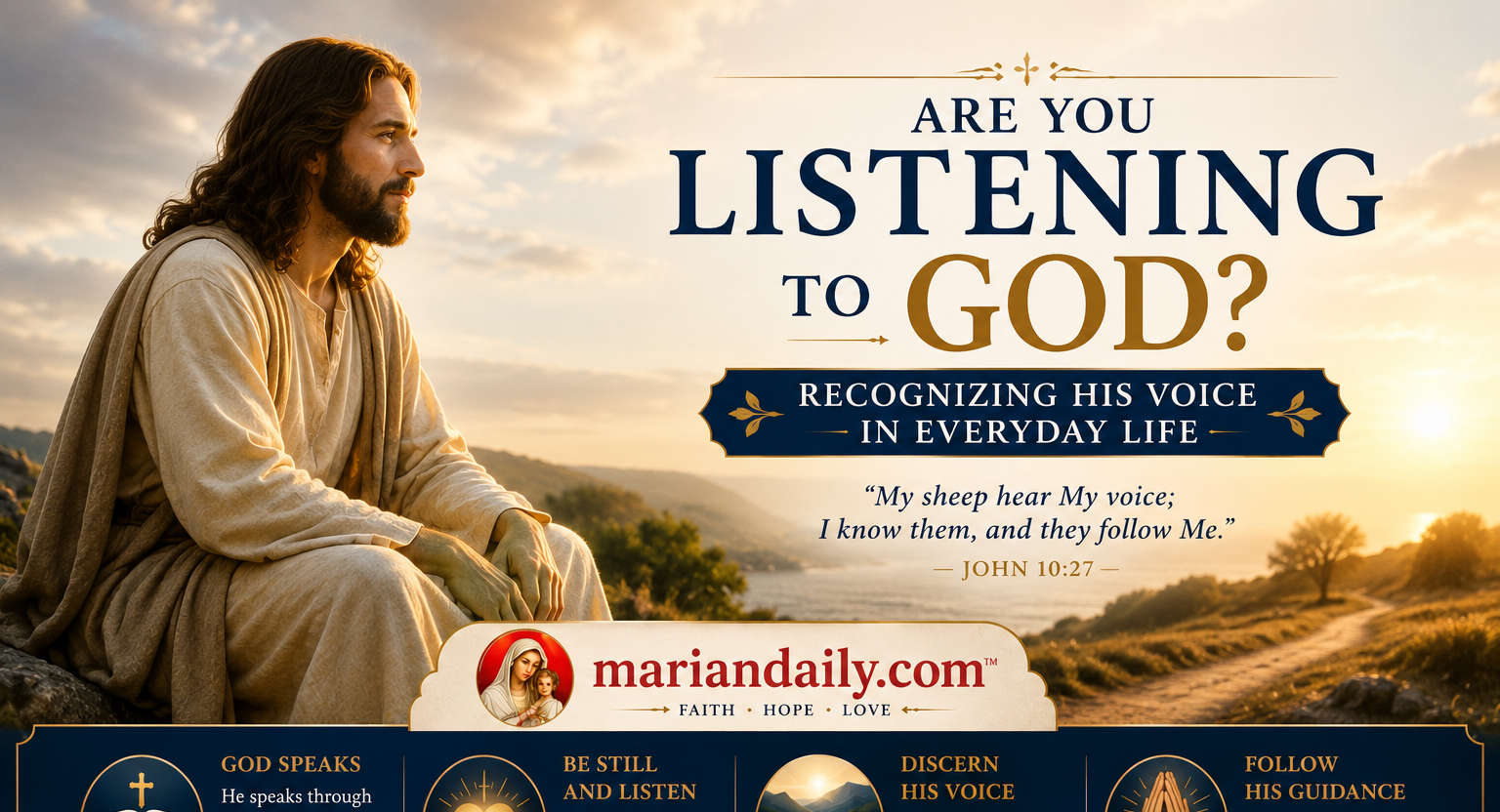
Many Catholics sincerely desire to follow God’s will but often struggle with a common question:
How does God speak to us today?
Unlike the dramatic events recorded in Sacred Scripture, most believers do not experience burning bushes, angelic apparitions, or voices from heaven. Yet the Catholic faith teaches that God continues to guide His people. He remains present, active, and involved in the lives of His children.
The challenge is not that God has stopped speaking. More often, the challenge is learning how to recognize His voice amid the noise, distractions, worries, and busyness of daily life.
God frequently communicates through prayer, Scripture, the teachings of the Church, circumstances, other people, and the quiet movements of grace within the heart. Learning to recognize these signs can help Catholics grow in wisdom, confidence, and trust in God’s providence.
Scripture Foundation
“Speak, Lord, for your servant is listening.” (1 Samuel 3:10)
The young Samuel’s response remains one of the most beautiful prayers in Scripture. It reminds believers that listening is an essential part of prayer and discipleship.
Does God Still Speak Today?
The Catholic Church teaches that public revelation ended with the death of the last Apostle. Everything necessary for salvation has already been revealed through Jesus Christ and handed on through Scripture and Sacred Tradition.
However, God continues to guide His people through His grace.
He speaks through:
- Sacred Scripture.
- The Holy Spirit.
- The teachings of the Church.
- Prayer.
- Wise spiritual counsel.
- Daily circumstances.
- The movements of conscience.
God’s communication today does not add new revelation but helps believers apply His eternal truth to their daily lives.
Why It Can Be Difficult to Hear God
Modern life is filled with distractions.
Many people begin and end their days surrounded by:
- Social media.
- News.
- Entertainment.
- Work pressures.
- Constant notifications.
When the mind is continually occupied, it becomes difficult to recognize God’s gentle guidance.
Scripture often portrays God speaking in quiet ways rather than dramatic displays.
The prophet Elijah encountered God not in the wind, earthquake, or fire, but in a gentle whisper.
God frequently speaks in a similar manner today.
To hear Him, believers must learn the value of silence and attentiveness.
God Speaks Through Sacred Scripture
One of the most reliable ways to hear God’s voice is through His Word.
The Bible is not merely a historical record.
It is God’s living Word addressed to His people.
When Catholics prayerfully read Scripture, God often:
- Provides encouragement.
- Offers correction.
- Reveals wisdom.
- Gives comfort.
- Strengthens faith.
Many believers discover that certain passages seem particularly relevant to their current circumstances.
This is one way God uses Scripture to guide His people.
God Speaks Through Prayer
Prayer is a conversation with God.
Many people focus primarily on speaking during prayer.
Yet listening is equally important.
After presenting petitions and concerns to God, it is helpful to spend time in quiet reflection.
During these moments, believers may receive:
- Greater clarity.
- Interior peace.
- Spiritual insight.
- A deeper awareness of God’s presence.
Listening prayer allows the heart to become receptive to God’s guidance.
God Speaks Through Conscience
The Catholic Church teaches that conscience plays an important role in moral decision-making.
A properly formed conscience helps believers recognize right from wrong and choose according to God’s will.
When Catholics experience a persistent interior conviction to do good, avoid sin, seek forgiveness, or act with charity, this may reflect God’s grace at work within the soul.
Conscience should always be formed according to Scripture, Church teaching, and sound moral principles.
God Speaks Through the Church
Jesus entrusted His teaching authority to the Church.
Because of this, Catholics should always evaluate personal inspirations in light of Catholic doctrine.
God never contradicts Himself.
Any message that opposes Scripture, Sacred Tradition, or authentic Church teaching cannot come from God.
The Church provides guidance through:
- The Catechism.
- The Sacraments.
- Spiritual direction.
- Priests and faithful teachers.
- The wisdom of the saints.
These resources help believers discern God’s will more accurately.
God Speaks Through Other People
Sometimes God works through those around us.
A conversation, a piece of advice, an encouraging word, or a timely correction may become an instrument of God’s guidance.
Parents, friends, spouses, priests, and mentors can all help reveal God’s direction.
This does not mean every opinion is divinely inspired.
Rather, God often uses relationships to communicate wisdom and encouragement.
Discernment remains essential.
God Speaks Through Circumstances
God can also work through events and circumstances.
Closed doors, unexpected opportunities, challenges, and blessings may all become occasions for discernment.
Not every event represents a direct message from God.
However, believers can prayerfully ask:
- What is God teaching me through this situation?
- How can I respond faithfully?
- What virtues is He inviting me to develop?
Such reflection often reveals valuable spiritual lessons.
The Role of Interior Peace
One of the most important signs in discernment is genuine interior peace.
When a decision aligns with God’s will, believers often experience a deep sense of peace despite uncertainty.
This does not mean every difficult decision will feel easy.
Rather, God’s guidance frequently brings confidence and trust even when challenges remain.
Anxiety alone should not determine decisions, but authentic peace can be a valuable indicator of God’s direction.
The Blessed Virgin Mary as a Model Listener
The Blessed Virgin Mary provides one of the greatest examples of listening to God.
At the Annunciation, Mary received God’s invitation through the Angel Gabriel.
Her response demonstrated humility, faith, and openness:
“Behold, I am the handmaid of the Lord. May it be done to me according to your word.” (Luke 1:38)
Throughout her life, Mary listened attentively to God’s will.
Scripture tells us that she pondered events in her heart.
Catholics can imitate Mary’s example by cultivating silence, prayer, trust, and obedience.
Practical Ways to Listen More Closely to God
Spend Time in Silence
Create moments free from distractions and noise.
Read Scripture Daily
Allow God’s Word to shape your thinking.
Pray Consistently
Develop a regular prayer routine.
Receive the Sacraments
The Eucharist and Reconciliation strengthen spiritual discernment.
Pray the Rosary
The Rosary helps believers reflect on Christ’s life through Mary’s eyes.
Seek Wise Counsel
Consult trusted spiritual guides when making important decisions.
Practice Patience
God’s guidance often unfolds gradually rather than instantly.
Common Mistakes in Discernment
Many people misunderstand God’s guidance.
Common mistakes include:
- Expecting dramatic signs.
- Ignoring Church teaching.
- Confusing emotions with God’s voice.
- Acting impulsively without prayer.
- Seeking only personal preferences.
Authentic discernment requires humility, patience, prayer, and obedience.
Reflection
God continues to speak to His people today.
His voice may not always be dramatic or obvious, but it remains present for those willing to listen.
Through Scripture, prayer, conscience, the Church, daily circumstances, and the quiet movements of grace, God continually invites believers into deeper relationship with Him.
Learning to recognize His voice requires attentiveness, patience, and trust.
The more time Catholics spend in prayer and faithful discipleship, the more familiar God’s guidance becomes.
Like Samuel, every believer is invited to pray:
“Speak, Lord, for your servant is listening.”
Closing Prayer
Heavenly Father,
Open our hearts to hear Your voice.
Help us set aside distractions and become attentive to Your guidance.
Teach us to listen through prayer, Scripture, the teachings of the Church, and the quiet movements of grace within our souls.
Through the example of the Blessed Virgin Mary, help us respond with faith, humility, and trust.
May we always seek Your will and follow wherever You lead.
Through Christ our Lord.
Amen.
Related Articles
 Why Does God Allow Suffering? A Catholic Reflection on Faith, Hope, and Trust
 Finding Peace in Uncertain Times: A Catholic Reflection on God’s Providence
 The Hidden Power of Daily Prayer: Small Habits That Change the Soul
 The Forgotten Catholic Practices That Can Strengthen Your Faith
 7 Signs God May Be Calling You Closer to Him
 The Difference Between Happiness and Joy: A Christian Perspective