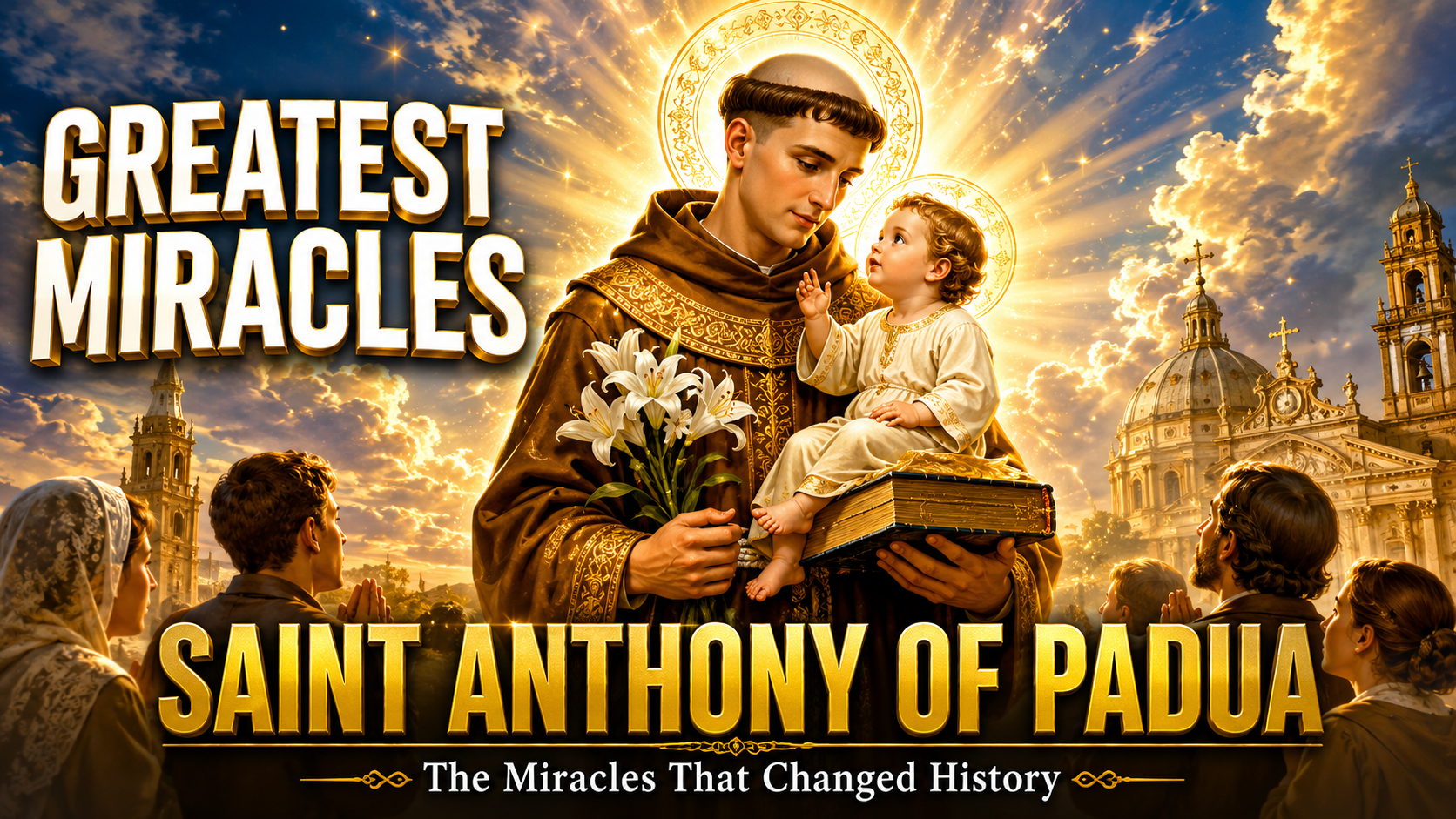
The miracles of Saint Anthony of Padua have fascinated Catholics for nearly eight centuries. But what do these extraordinary stories actually teach us about faith, prayer, and God’s work in our lives?
Saint Anthony became famous as a powerful preacher and beloved Franciscan saint. Catholic tradition connects his life with remarkable accounts involving fish, a mule, a dead man, and a stolen prayer book. These stories helped generations of Christians see God’s power at work through a life completely surrendered to Christ.
However, the miracles of Saint Anthony of Padua are not simply fascinating stories from the past. They also point toward deeper truths about faith, conversion, the Eucharist, God’s mercy, and the search for what we have lost.
In this article, we will explore four famous miracle accounts associated with Saint Anthony. We will also examine their historical context, Catholic meaning, biblical connections, and practical lessons for Christians today.
Who Was Saint Anthony of Padua?
Before exploring the miracles of Saint Anthony of Padua, we should understand the man behind the stories.
Saint Anthony was born in Lisbon, Portugal, around 1195. His baptismal name was Fernando Martins de Bulhões. As a young man, he joined the Canons Regular of Saint Augustine and devoted himself to prayer and study.
Later, however, his life took a dramatic turn.
Anthony became deeply inspired by five Franciscan friars who died as martyrs while preaching the Gospel in Morocco. Their witness moved him so deeply that he joined the Franciscan Order.
Anthony originally hoped to preach among Muslims and perhaps become a martyr himself. Yet God led him in another direction.
After illness prevented his missionary plans, Anthony eventually became known throughout Europe as an extraordinary preacher. His knowledge of Scripture, courage, humility, and ability to communicate the Catholic faith attracted large crowds.
Moreover, his reputation reached Saint Francis of Assisi. Francis recognized Anthony’s gifts and entrusted him with teaching theology to the friars.
Therefore, Anthony’s influence did not come from miracles alone. His life centered first on Christ, Scripture, prayer, and service.
He died near Padua, Italy, in 1231. The Church canonized him in 1232, remarkably soon after his death. Today, Catholics throughout the world honor him as Saint Anthony of Padua, although he was born in Lisbon.
The Miracles of Saint Anthony of Padua: What Do They Mean?
The miracles of Saint Anthony of Padua appear in traditional biographies and accounts connected with his life and early veneration.
At the same time, Catholics should understand how the Church approaches miracle stories.
The Church does not ask believers to treat every popular story as though it were a modern scientific report. Instead, Catholic tradition carefully distinguishes between:
- Historical evidence.
- Early biographical accounts.
- Devotional traditions.
- Theological reflection.
- Miracles formally recognized by the Church.
Consequently, the stories below should be understood within the broader tradition surrounding Saint Anthony.
Their purpose goes beyond wonder. Each story points toward a spiritual lesson.
The fish remind us of creation responding to God’s truth. The mule story points toward faith in Christ’s Eucharistic presence. The resurrection account emphasizes truth and justice. Finally, the stolen psalter reveals Anthony’s association with recovering what has been lost.
Let us examine each account.
Miracle One: Saint Anthony Preaches to the Fish
One of the most famous miracles of Saint Anthony of Padua tells of a remarkable event in Rimini, Italy.
According to the traditional account, Anthony traveled to Rimini to preach the Gospel. However, many people refused to listen. Instead, they rejected his message and turned away.
Anthony did not respond with anger.
Instead, he went toward the water and began preaching to the fish.
Then something extraordinary happened.
According to the story, large numbers of fish gathered near the surface. They appeared to face Anthony as he preached. The unusual sight reportedly astonished those who witnessed it.
As a result, some of the people who had rejected Anthony’s preaching reconsidered their actions. The event became known as the Sermon to the Fish.
The story connects beautifully with Scripture. Psalm 96:11 calls upon the sea and everything within it to rejoice before the Lord.
Likewise, Psalm 148 invites the creatures of the sea to praise God.
The spiritual lesson is simple but powerful: creation belongs to God.
If even creation responds to its Creator, then human beings should also open their hearts to God’s truth.
A Lesson for Our Own Lives
Sometimes we also become like the people of Rimini.
We may hear God’s word but refuse to listen. Perhaps pride distracts us. Maybe disappointment makes us skeptical. At other times, suffering closes our hearts.
Yet Saint Anthony’s story reminds us to listen again.
God may speak through Scripture, prayer, the Church, or the quiet witness of another person.
Therefore, the first lesson of this miracle is not simply that fish gathered around a preacher. It is a call to become listeners.
Miracle Two: The Mule Who Knelt Before the Eucharist
Another famous account among the miracles of Saint Anthony of Padua involves a man named Bonvillo.
According to tradition, this man struggled to accept the Catholic belief in the Real Presence of Christ in the Eucharist.
Anthony reportedly challenged him to witness a test.
The man’s mule had gone without food for several days. At the appointed time, Anthony stood nearby with the Blessed Sacrament, while someone placed food on the other side.
According to the traditional story, the mule ignored the food and moved toward the Eucharist. The animal then knelt before the Blessed Sacrament.
The account became a powerful part of Saint Anthony’s devotional tradition.
However, the deeper Catholic lesson does not rest on the behavior of an animal alone.
The Catholic Church teaches that Jesus Christ is truly present in the Eucharist. The Catechism explains that Christ is present in the Eucharist in a unique and substantial way.
Therefore, the story directs attention toward the mystery of the Eucharist.
Jesus Himself said:
“I am the bread of life.”
In the Gospel of John, Christ teaches that He gives Himself as spiritual food for His people.
Consequently, the mule story invites believers to examine their own faith.
Do we approach the Eucharist with reverence?
Do we recognize the gift we receive at Mass?
Do we allow Christ’s presence to transform our daily lives?
The story, whether considered as a traditional miracle account or as part of Anthony’s devotional legacy, points toward a central Catholic belief: Christ deserves our worship and love.
Miracle Three: The Dead Man Who Testified
Among the most dramatic miracles of Saint Anthony of Padua is the account of a murdered man who reportedly returned to life temporarily.
According to the traditional narrative, a man in Padua had been murdered. Authorities accused his own father of the crime.
Anthony, however, knew that the man was innocent.
According to the account, Anthony went to the place where the dead man lay. There, he called upon him to speak.
The story says that the dead man rose and declared his father’s innocence before witnesses. Afterwards, he returned to rest.
This account appears in early traditions surrounding Saint Anthony’s life and his canonization process.
At the same time, it is important to describe such accounts carefully. Modern readers cannot independently verify every detail using contemporary historical methods.
Nevertheless, the story carries a powerful spiritual message.
Truth matters.
Justice matters.
The innocent deserve protection.
Saint Anthony’s traditional role in this story reflects the Christian belief that God cares deeply about truth and justice.
Scripture repeatedly calls believers to defend the innocent and reject false accusations. Therefore, this story encourages Christians to seek truth rather than accept rumors or unjust judgments.
It also reminds us that God sees what human beings cannot see.
When someone suffers unjustly, God does not forget.
Miracle Four: Saint Anthony and the Lost Psalter
Perhaps the most beloved of the miracles of Saint Anthony of Padua concerns a stolen prayer book.
According to tradition, a novice took Anthony’s personal psalter. The book held special significance because it contained Anthony’s handwritten notes and reflections.
When Anthony discovered the theft, he prayed.
The story says that the novice later experienced such intense fear and remorse that he returned the book.
This account helped strengthen Saint Anthony’s reputation as the patron saint of lost things.
Over the centuries, Catholics began turning to him when they misplaced something important.
Many people know the popular prayer:
“Saint Anthony, Saint Anthony, please come around; something is lost and cannot be found.”
The prayer has become part of Catholic popular devotion.
However, Saint Anthony’s intercession can mean much more than finding lost keys, wallets, or documents.
Sometimes, we lose things that no one else can see.
We may lose:
- Our sense of peace.
- Our confidence in God’s love.
- A relationship.
- A sense of direction.
- Hope after suffering.
- The desire to pray.
- Our closeness to God.
Therefore, the devotion to Saint Anthony can become a reminder that God seeks what is lost.
Jesus expressed this truth in the parable of the lost sheep:
“What man among you, if he has a hundred sheep and loses one of them, does not leave the ninety-nine… and go after the one which is lost until he finds it?”
This Gospel passage reveals God’s merciful heart.
God does not abandon those who wander.
Instead, He searches.
What the Miracles of Saint Anthony of Padua Teach Catholics Today
The miracles of Saint Anthony of Padua offer several practical lessons for modern Christians.
1. Put Christ at the Center
Saint Anthony’s life focused on Jesus Christ.
Therefore, Catholics should not become so fascinated by miracles that they forget the One behind them.
The saints always point beyond themselves.
2. Trust God’s Timing
Anthony wanted to preach in Morocco. Instead, God gave him another mission.
His story reminds us that unanswered plans do not always mean unanswered prayers.
Sometimes, God redirects us toward a purpose we cannot yet understand.
3. Defend the Truth
The story of the dead man who testified reminds us to value truth.
Christians should avoid gossip, false accusations, and careless judgments.
Instead, we should seek justice and speak with charity.
4. Return to Prayer
The story of the stolen psalter reminds us that prayer can restore what seems lost.
When life becomes confusing, return to God.
Even a simple prayer can become the beginning of renewal.
5. Remember the Eucharist
The mule story directs our attention toward the Blessed Sacrament.
Therefore, Catholics should approach the Eucharist with faith, reverence, and gratitude.
6. Become a Witness
Anthony did not keep his faith hidden.
He preached the Gospel boldly.
Today, Christians can follow his example through simple acts of evangelization. A kind word, a Scripture verse, or an invitation to Mass can touch someone’s life.
What Does the Catholic Church Teach About Miracles?
The Catholic Church believes that God can perform miracles.
However, Catholics do not worship miracles.
Instead, miracles point toward God’s power and invite people to deeper faith.
The Church also exercises discernment when investigating extraordinary events. In the case of canonization, the Church examines evidence carefully and follows established procedures.
Furthermore, Catholic teaching emphasizes that God’s ordinary grace remains central to Christian life.
We encounter God through:
- Sacred Scripture.
- The Sacraments.
- Prayer.
- The Eucharist.
- The Church.
- Works of charity.
- The lives and witness of the saints.
Therefore, Christians should never treat saints as magical figures.
Catholics ask saints to intercede because they believe the saints live with God and continue to pray for the Church.
Saint Anthony, therefore, does not replace Jesus.
Instead, devotion to him should lead us closer to Jesus.
How to Ask Saint Anthony for Help Today
If something feels lost in your life, you can turn to God in prayer and ask for Saint Anthony’s intercession.
Try these simple steps:
- Name what you have lost.
Be honest with God about your situation. - Pray without fear.
Ask Saint Anthony to intercede for you. - Trust God’s wisdom.
Remember that God’s answer may differ from what you expect. - Take practical action.
If you lost something physical, search carefully. If you lost hope, seek support and return to prayer. - Remain patient.
God’s grace often works gradually. - Give thanks.
Thank God for His presence, whether or not the outcome matches your desire.
Above all, remember this: asking Saint Anthony for help means asking a saint to pray with you and for you.
Frequently Asked Questions About the Miracles of Saint Anthony of Padua
1. What are the most famous miracles of Saint Anthony of Padua?
The most famous miracles of Saint Anthony of Padua include the Sermon to the Fish, the mule kneeling before the Eucharist, the resurrection of a murdered man, and the recovery of Anthony’s stolen psalter.
2. Why is Saint Anthony the patron saint of lost things?
Saint Anthony became associated with lost things because of the traditional story of his stolen psalter. After the book returned, Catholics increasingly sought his intercession when they lost important objects.
3. Did Saint Anthony really preach to fish?
The Sermon to the Fish belongs to the traditional accounts of Saint Anthony’s life. Catholics have preserved the story for centuries, although modern historical methods cannot independently verify every detail of the event.
4. What do the miracles of Saint Anthony of Padua teach us?
The miracles of Saint Anthony of Padua encourage faith, humility, trust in God, love for the Eucharist, concern for justice, and hope for those who feel spiritually lost.
5. Can Catholics pray directly to Saint Anthony?
Yes. Catholics may ask Saint Anthony to intercede for them. However, Catholic prayer ultimately remains directed toward God, and the saints do not replace Jesus Christ.
6. What prayer can I say when I lose something?
You can simply ask Saint Anthony to pray for you. A traditional devotional prayer begins, “Saint Anthony, Saint Anthony, please come around.”
7. Is Saint Anthony only the patron saint of lost objects?
No. Catholics also invoke Saint Anthony for many other needs. His ministry as a preacher and defender of the faith makes him an important model of evangelization and Christian discipleship.
8. When is the feast of Saint Anthony of Padua?
The Catholic Church celebrates the feast of Saint Anthony of Padua on June 13.
Conclusion: What We Can Learn From the Miracles of Saint Anthony of Padua
The miracles of Saint Anthony of Padua continue to capture the imagination of Catholics around the world.
From the fish that gathered to hear his preaching to the mule that knelt before the Eucharist, these traditional accounts point toward deeper spiritual realities.
The story of the dead man reminds us to value truth and justice. Meanwhile, the story of the stolen psalter reminds us that God can help us recover what we thought was gone forever.
Yet the greatest lesson may be this: Saint Anthony always points us back to Christ.
If you feel that something has been lost in your life, do not give up.
Bring that loss to God.
Ask Saint Anthony to intercede for you. Then remain patient and trust God’s loving plan.
Perhaps what you need to find is not an object.
Perhaps you need to rediscover hope.
Perhaps you need to return to prayer.
Perhaps you need to find your way back to Jesus.
Whatever you have lost, remember that God has not lost sight of you.
Have you ever prayed to Saint Anthony after losing something important—or when you felt that you had lost hope, peace, or direction?
Share your experience in the comments. Your story may encourage someone else who is going through a difficult time.
If this reflection on the miracles of Saint Anthony of Padua touched your heart, please share it with a friend or family member who may need encouragement today.
For more Catholic stories, prayers, saints, and reflections, subscribe to our future Catholic content and continue growing in faith with us.
For research and further reading, consider linking to these trustworthy sources:
- The Holy See — Vatican
- Catechism of the Catholic Church — Vatican
- United States Conference of Catholic Bishops
- Vatican News
- Catholic Encyclopedia — New Advent
Related Articles
 Divine Mercy Chaplet Prayer for Healing and Hope
 Incorrupt Saints: The Catholic Church’s Teaching Explained
 Forgiveness in Christianity: Jesus’ Call to Mercy
 Image of Our Lady of Guadalupe: History & Mystery
 Saint Anthony Prayer for Urgent Needs and Hope
 Hidden Christians of Japan: Faith That Survived 250 Years