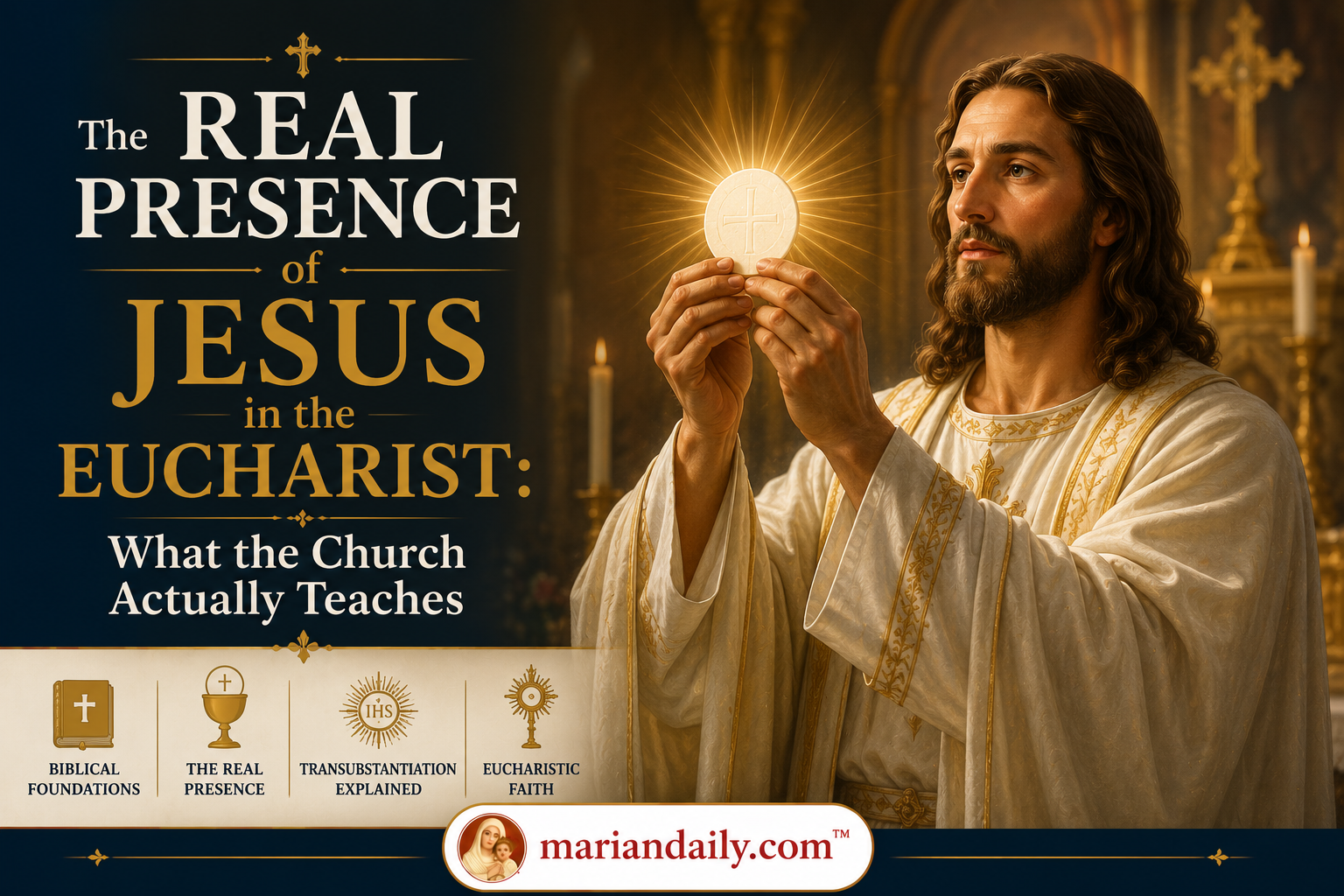
The Holy Eucharist stands at the very heart of the Catholic faith. Every day throughout the world, Catholics gather at the altar to celebrate the Holy Mass and receive Holy Communion. Yet one question continues to arise among Catholics and non-Catholics alike: Is Jesus truly present in the Eucharist, or is it merely a symbol?
The Catholic Church has consistently taught from the time of the Apostles that Jesus Christ is truly, really, and substantially present in the Eucharist. This belief is known as the Real Presence. It is not a later invention, a medieval idea, or a symbolic interpretation. It comes directly from the teachings of Christ Himself and has been preserved by the Church for nearly two thousand years.
Understanding the Real Presence helps Catholics appreciate the immense gift offered at every Mass. It transforms the way we worship, pray, receive Holy Communion, and approach the Blessed Sacrament.
Scripture Foundation
“For my flesh is true food, and my blood is true drink. Whoever eats my flesh and drinks my blood remains in me and I in him.” (John 6:55–56)
These words of Jesus form the foundation of Catholic belief in the Eucharist. Rather than speaking symbolically, Christ spoke with remarkable clarity about giving His Body and Blood as spiritual nourishment for His followers.
What Does the Church Mean by the Real Presence?
When Catholics speak about the Real Presence, they mean that Jesus Christ is truly present in the Eucharist—Body, Blood, Soul, and Divinity.
After the consecration during Mass, the bread and wine no longer remain ordinary bread and wine. Although their appearance remains unchanged, their substance is transformed into Christ Himself.
This means Catholics do not receive a symbol of Jesus during Holy Communion. They receive Jesus Christ Himself.
The Church teaches that Christ is present in many ways within the life of the Church. He is present in Sacred Scripture, in the gathered faithful, in the poor, and in the sacraments. However, His presence in the Eucharist is unique because it is a substantial presence.
For this reason, the Eucharist occupies a special place in Catholic worship and devotion.
Jesus’ Teaching in John Chapter 6
One of the strongest biblical foundations for the Real Presence is found in John Chapter 6.
After miraculously feeding thousands of people, Jesus began teaching about the Bread of Life. He told the crowd that He would give His flesh for the life of the world.
Many listeners were shocked.
“How can this man give us his flesh to eat?” (John 6:52)
Instead of correcting them or explaining that He was speaking symbolically, Jesus repeated His teaching with even greater emphasis.
Many disciples found this teaching difficult and left Him.
Remarkably, Jesus allowed them to leave. If they had misunderstood Him, this would have been the ideal moment to clarify His words. Instead, He reaffirmed the teaching and asked the Apostles whether they also wished to leave.
This passage has always been understood by the Catholic Church as a powerful testimony to the Real Presence.
The Last Supper and the Institution of the Eucharist
The Last Supper provides another essential foundation for Catholic belief.
During the Passover meal, Jesus took bread and said:
“This is my body.”
Then He took the cup and said:
“This is my blood.”
He did not say:
- This represents my body.
- This symbolizes my body.
- This reminds you of my body.
He simply said:
“This is my body.”
The Church takes Christ’s words seriously and literally.
At every Mass, the priest repeats the words of Christ during the consecration. Through the power of the Holy Spirit, the bread and wine become the Body and Blood of Jesus Christ.
This same Eucharistic mystery has been celebrated continuously since the apostolic age.
What Is Transubstantiation?
The Church uses the term Transubstantiation to explain what happens during the consecration.
While the appearances of bread and wine remain the same, their substance is changed completely into Christ Himself.
This teaching does not attempt to explain how God performs this miracle. Rather, it describes what the Church believes occurs through God’s power.
The Eucharist continues to look, taste, and feel like bread and wine. Yet faith tells us that beneath these appearances Christ is truly present.
The Church adopted this language to defend the reality of Christ’s presence and avoid reducing the Eucharist to a mere symbol.
What Did the Early Christians Believe?
The belief in the Real Presence did not begin centuries after Christ. It can be found in the earliest Christian writings.
Early Church Fathers repeatedly described the Eucharist as the true Body and Blood of Christ.
Saint Ignatius of Antioch, writing around the year 107 AD, spoke about those who refused to believe that the Eucharist is the flesh of Jesus Christ.
Saint Justin Martyr, writing in the second century, explained that Christians did not receive ordinary bread and drink but the Body and Blood of Christ.
These early testimonies show that belief in the Real Presence existed from the earliest generations of Christianity.
The Catholic Church has preserved this teaching faithfully throughout the centuries.
Why Is the Eucharist Called the Source and Summit of Christian Life?
The Church describes the Eucharist as the source and summit of the Christian life because it contains Christ Himself.
Every sacrament points toward Christ.
Every prayer ultimately leads to Christ.
Every act of worship finds its fulfillment in Christ.
Since Jesus is truly present in the Eucharist, the Eucharist becomes the center of Catholic life.
Through Holy Communion, believers receive spiritual nourishment, grace, strength, and deeper union with God.
The Eucharist is not simply one devotion among many. It is the heart of Catholic worship.
Why Do Catholics Adore the Blessed Sacrament?
If Jesus is truly present in the Eucharist, then worship and adoration naturally follow.
Catholics do not adore bread.
They adore Jesus Christ present under the appearance of bread.
This belief explains practices such as:
- Eucharistic Adoration
- Benediction
- Processions with the Blessed Sacrament
- Prayer before the tabernacle
When Catholics kneel before the Blessed Sacrament, they are expressing faith in the Real Presence of Christ.
These devotions help deepen love for Jesus and strengthen Eucharistic faith.
How Should Catholics Prepare for Holy Communion?
Belief in the Real Presence should influence the way Catholics prepare for Holy Communion.
The Church encourages the faithful to:
- Be in a state of grace.
- Observe the Eucharistic fast.
- Approach reverently.
- Participate prayerfully in Mass.
- Spend time in thanksgiving after Communion.
Receiving Holy Communion is one of the most intimate encounters a Catholic can have with Christ on earth.
Preparation helps the faithful receive this gift more fruitfully.
Common Misunderstandings About the Eucharist
Several misunderstandings continue to circulate regarding Catholic teaching.
Some believe Catholics worship bread. This is false. Catholics worship Jesus Christ.
Others believe the Eucharist is merely symbolic. The Church has consistently rejected this interpretation.
Some think belief in the Real Presence developed later in history. Historical evidence demonstrates that Christians believed in Christ’s Eucharistic presence from the earliest centuries.
Understanding authentic Catholic teaching helps remove confusion and strengthens faith.
What Difference Should the Real Presence Make in Daily Life?
Belief in the Real Presence is not merely a theological concept.
It should transform the way Catholics live.
If Jesus is truly present in the Eucharist, then:
- Mass becomes a sacred encounter.
- Holy Communion becomes a priceless gift.
- Adoration becomes a privileged opportunity.
- Reverence becomes natural.
- Gratitude becomes essential.
The more Catholics appreciate the Real Presence, the more they are drawn into a deeper relationship with Christ.
Faith in the Eucharist strengthens prayer, increases love for God, and inspires holiness.
Reflection
The Real Presence of Jesus in the Eucharist remains one of the most beautiful and profound teachings of the Catholic faith.
At every Mass, Christ fulfills His promise to remain with His people. Through the Eucharist, He nourishes souls, strengthens believers, and draws humanity into communion with God.
The Church’s teaching has remained unchanged from the Apostles to the present day.
Catholics believe that the Eucharist is not merely a symbol or reminder. It is Jesus Christ Himself—Body, Blood, Soul, and Divinity.
This truth invites every believer to approach the altar with faith, reverence, gratitude, and love.
Closing Prayer
Lord Jesus Christ,
We thank You for the gift of the Holy Eucharist and for Your promise to remain with Your Church until the end of time.
Increase our faith in Your Real Presence. Help us to approach Holy Communion with reverence, devotion, and gratitude.
Draw us closer to You through every Mass and every encounter with the Blessed Sacrament.
May our love for the Eucharist deepen each day and lead us toward greater holiness and union with You.
Amen.
Related Articles
 10 Things Every Catholic Should Know Before Receiving Holy Communion
 The Angelus Prayer Explained: Meaning, History and How to Pray It
 The Divine Mercy Chaplet Explained: Origins, Promises, and How to Pray It
 What Every Catholic Family Should Have in Their Home for Spiritual Growth
 How the Blessed Virgin Mary Teaches Us to Trust God Completely
 Eucharistic Miracles Scientists Could Not Explain