The Divine Mercy Chaplet is one of the most beloved Catholic devotions in the world. Prayed daily by millions of faithful Catholics, this powerful prayer focuses on God’s infinite mercy, the saving Passion of Jesus Christ, and the hope of salvation for all who trust in Him.
Although relatively recent compared to ancient devotions such as the Rosary, the Divine Mercy Chaplet has become a central part of Catholic spirituality. It is closely connected to the revelations received by Saint Faustina Kowalska, the message of Divine Mercy, and the Church’s call to trust completely in Jesus.
Many Catholics are familiar with the Chaplet but may not fully understand its origins, promises, or proper method of prayer. Learning more about this devotion can deepen appreciation for God’s mercy and strengthen one’s spiritual life.
Scripture Foundation
“Jesus, I trust in You.”
While not a direct biblical quotation, this phrase summarizes the message of Divine Mercy and reflects the words of Christ:
“For God so loved the world that he gave his only Son, so that everyone who believes in him might not perish but might have eternal life.” (John 3:16)
The Divine Mercy devotion continually points believers toward trust in Jesus and confidence in His saving mercy.
What Is the Divine Mercy Chaplet?
The Divine Mercy Chaplet is a prayer that focuses on the Passion of Jesus Christ and offers His sacrifice to the Father for the forgiveness of sins and the salvation of souls.
Using ordinary Rosary beads, the faithful meditate on Christ’s mercy while praying for themselves, their loved ones, sinners, the dying, and the whole world.
The Chaplet is shorter than the Rosary and can usually be prayed in about ten minutes.
Its central theme is simple yet profound:
God’s mercy is greater than human sin.
This message has brought hope to countless people seeking forgiveness, healing, and reconciliation with God.
The Origins of the Divine Mercy Chaplet
The Divine Mercy devotion is closely connected to Saint Faustina Kowalska, a Polish nun who lived from 1905 to 1938.
Saint Faustina belonged to the Congregation of the Sisters of Our Lady of Mercy. Throughout her religious life, she experienced extraordinary mystical encounters with Jesus.
In her spiritual diary, she recorded numerous conversations in which Christ emphasized His desire that the world come to know and trust His mercy.
According to Saint Faustina’s writings, Jesus taught her the Divine Mercy Chaplet in 1935 and instructed her to spread this prayer throughout the world.
The Chaplet quickly became one of the most important elements of the Divine Mercy message.
The Divine Mercy Image
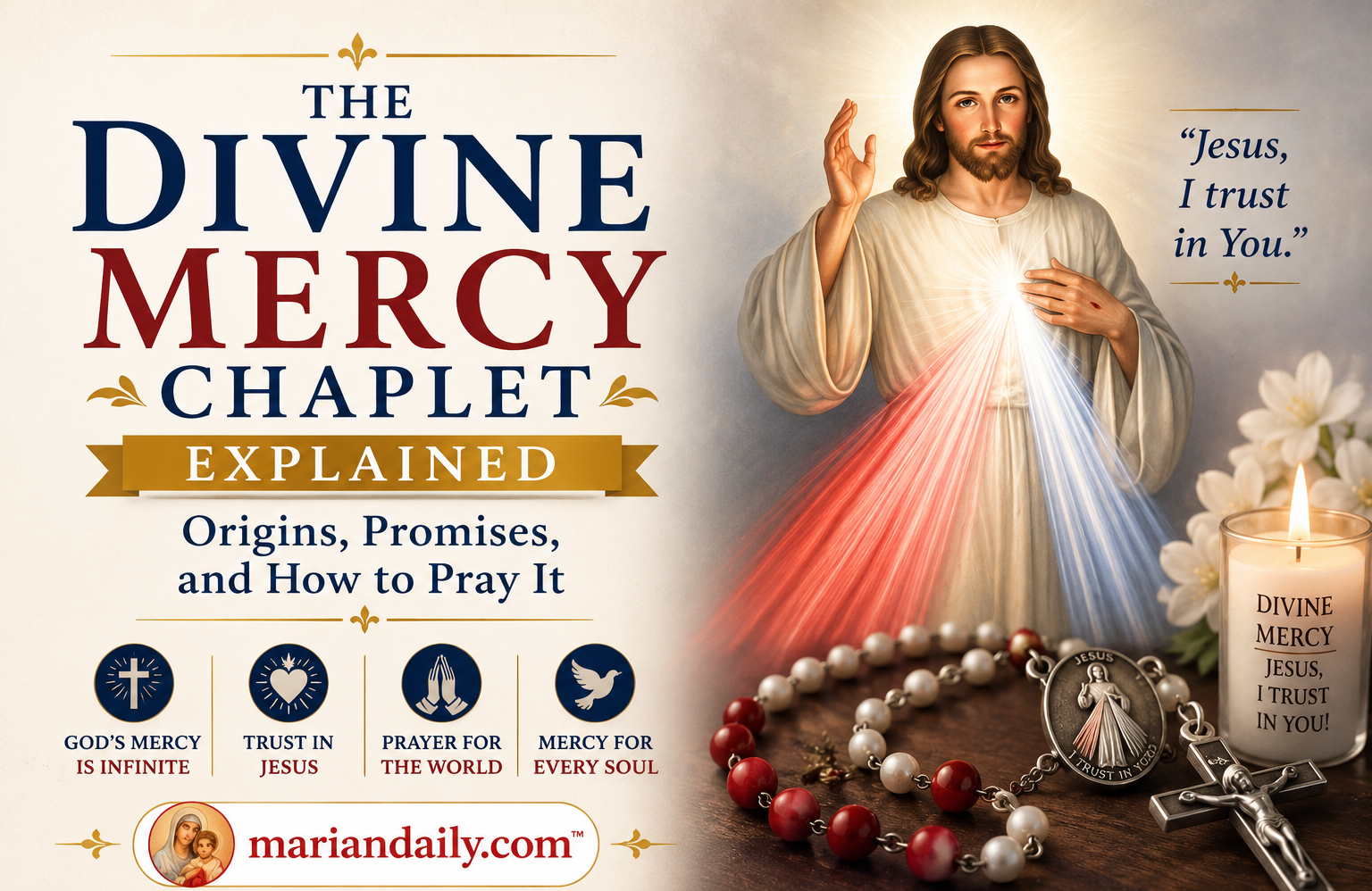
One of the most recognizable aspects of the devotion is the Divine Mercy image.
In the image, Jesus is shown raising one hand in blessing while two rays flow from His Heart:
- A pale ray representing water.
- A red ray representing blood.
These rays recall the water and blood that flowed from Christ’s side on the Cross.
At the bottom of the image appear the words:
“Jesus, I trust in You.”
The image serves as a visual reminder of God’s mercy and Christ’s saving love.
The Main Themes of Divine Mercy
The Divine Mercy devotion emphasizes several important spiritual truths.
God’s Mercy Is Infinite
No sin is greater than God’s mercy.
Christ continually invites sinners to return to Him with trust and repentance.
Trust in Jesus
Trust lies at the heart of the devotion.
The more believers trust Christ, the more fully they open themselves to His grace.
Mercy Toward Others
Those who receive God’s mercy are called to share mercy with others through forgiveness, compassion, and charity.
The Passion of Christ
The Chaplet focuses on Christ’s sacrifice on the Cross, which obtained salvation for humanity.
The Promises Associated with the Divine Mercy Chaplet
The Church distinguishes between public revelation, which ended with the Apostles, and private revelations such as those received by Saint Faustina.
Catholics are not required to believe private revelations. However, the Church has approved the Divine Mercy devotion as worthy of belief and practice.
According to Saint Faustina’s diary, Jesus attached many spiritual promises to the Chaplet.
Among them:
Assistance at the Hour of Death
Jesus promised special graces for those who faithfully pray the Chaplet and for those for whom it is prayed.
Greater Confidence in Mercy
The Chaplet helps believers approach God with trust rather than fear.
Peace for Sinners
The devotion encourages repentance and confidence in God’s forgiveness.
Intercession for the World
The prayer can be offered for families, nations, the suffering, and those most in need of God’s mercy.
The Church reminds believers that these promises should always be understood within the broader context of faith, repentance, and participation in the sacramental life of the Church.
Why Catholics Pray at Three O’Clock
Many Catholics pray the Divine Mercy Chaplet at 3:00 PM.
This time is often called the Hour of Mercy because it recalls the hour of Christ’s death on the Cross.
Jesus encouraged Saint Faustina to meditate on His Passion during this hour whenever possible.
Praying at 3:00 PM is not required, but many Catholics find it a meaningful way to remember Christ’s sacrifice.
How to Pray the Divine Mercy Chaplet
The Chaplet is prayed using ordinary Rosary beads.
Opening Prayers
Begin with:
In the name of the Father, and of the Son, and of the Holy Spirit. Amen.
Optional opening prayers may also be included.
Our Father
Pray one Our Father.
Hail Mary
Pray one Hail Mary.
Apostles’ Creed
Pray the Apostles’ Creed.
On the Large Beads
Pray:
Eternal Father, I offer You the Body and Blood, Soul and Divinity of Your dearly beloved Son, Our Lord Jesus Christ, in atonement for our sins and those of the whole world.
On the Small Beads
Pray ten times:
For the sake of His sorrowful Passion, have mercy on us and on the whole world.
Repeat for Five Decades
Continue through all five decades of the Rosary beads.
Concluding Prayer
Repeat three times:
Holy God, Holy Mighty One, Holy Immortal One, have mercy on us and on the whole world.
Divine Mercy Sunday
Divine Mercy Sunday is celebrated on the Sunday after Easter.
Saint John Paul II officially established this feast for the universal Church in the year 2000 during the canonization of Saint Faustina.
The feast highlights God’s mercy and encourages the faithful to seek forgiveness through Confession and Holy Communion.
For many Catholics, Divine Mercy Sunday has become one of the most spiritually significant days of the liturgical year.
The Role of Saint John Paul II
Saint John Paul II played a major role in spreading the Divine Mercy devotion worldwide.
As a fellow Pole, he had a deep appreciation for Saint Faustina’s message.
Throughout his papacy, he repeatedly emphasized the importance of Divine Mercy for the modern world.
His teachings helped introduce millions of Catholics to the Chaplet and the broader message of trust in Christ.
Why the Divine Mercy Chaplet Remains Relevant Today
Modern society often struggles with anxiety, guilt, hopelessness, and fear.
The message of Divine Mercy offers a powerful response.
It reminds believers that:
- God never stops loving His children.
- Forgiveness is always possible through repentance.
- No one is beyond God’s mercy.
- Christ’s sacrifice remains the source of salvation.
The Chaplet provides a simple way to encounter these truths daily.
For many Catholics, it has become a source of peace during suffering, illness, grief, and uncertainty.
Reflection
The Divine Mercy Chaplet is far more than a collection of prayers.
It is an invitation to trust completely in Jesus Christ and His saving mercy.
Through this devotion, Catholics meditate on the Passion of Christ, pray for the needs of the world, and place their confidence in God’s love.
The message entrusted to Saint Faustina remains as important today as ever:
Jesus desires that humanity trust in His mercy.
When believers approach Him with faith, repentance, and confidence, they discover a God whose mercy knows no limits.
Closing Prayer
Merciful Jesus,
We place our trust completely in You.
Thank You for the gift of Your Divine Mercy and for Your sacrifice on the Cross for our salvation.
Help us turn to You with confidence, especially in moments of weakness, fear, and uncertainty.
Teach us to receive Your mercy with grateful hearts and to extend that same mercy to others.
May we always remember Your words and place our hope in Your unfailing love.
Jesus, we trust in You.
Amen.
Related Articles
 How to Pray the Rosary Step-by-Step (Complete Catholic Guide)
 How the Blessed Virgin Mary Teaches Us to Trust God Completely
 Finding Peace in Uncertain Times: A Catholic Reflection on God’s Providence
 The Sacred Heart of Jesus Devotion: Meaning, Promises, and Catholic Tradition
 The Hidden Power of Daily Prayer: Small Habits That Change the Soul
 Why Does God Allow Suffering? A Catholic Reflection on Faith, Hope, and Trust