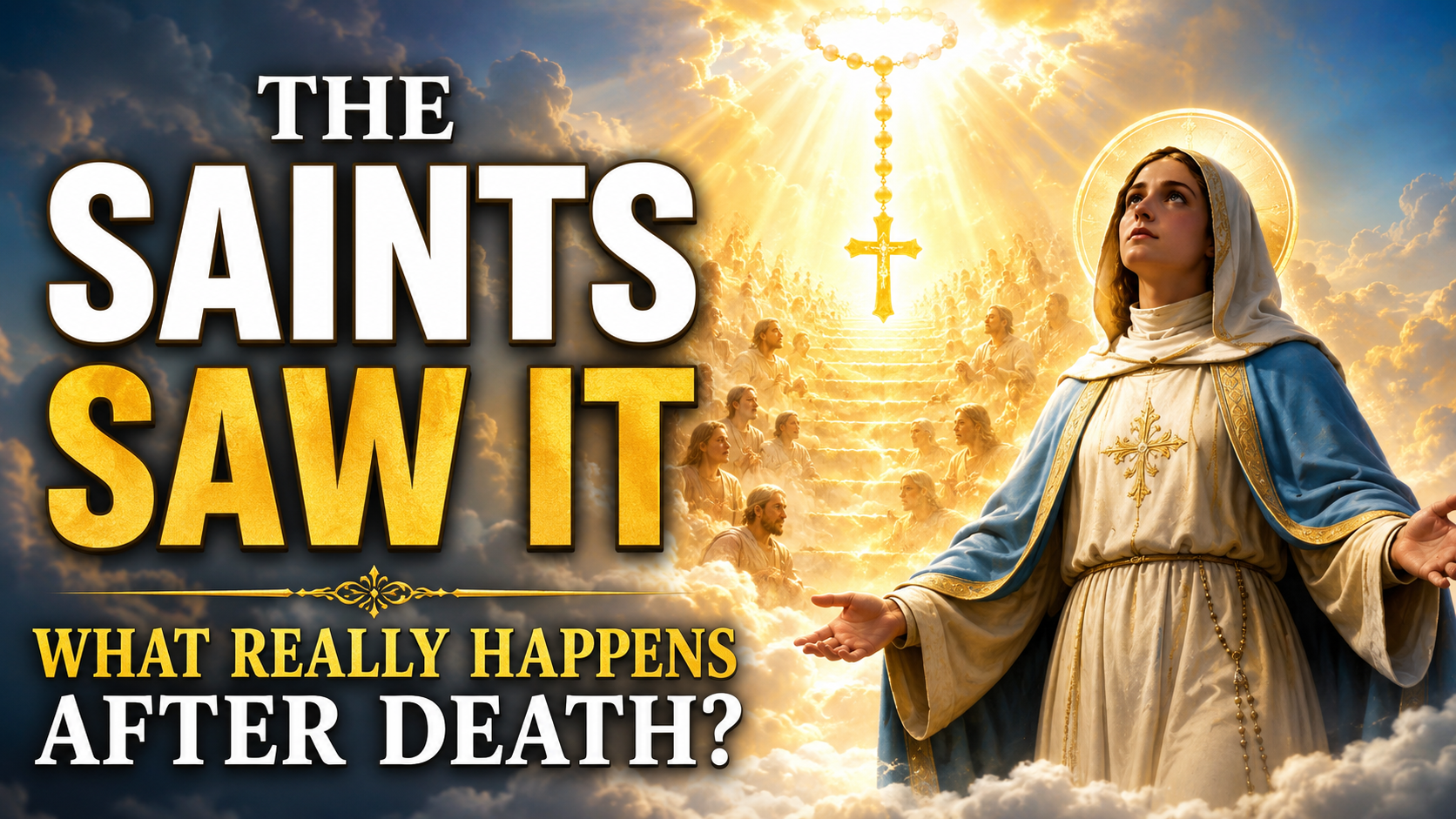
What does Purgatory look like according to the saints? For centuries, holy men and women have described extraordinary experiences that offer a glimpse into this profound Catholic mystery. Their accounts do not replace Sacred Scripture or official Church teaching. Instead, they can help us reflect more deeply on God’s justice, mercy, holiness, and love.
The Catholic Church teaches that Purgatory involves the final purification of souls who die in God’s friendship but still need purification before entering Heaven. Therefore, Purgatory should not make Christians despair. Rather, it reveals the hope that God’s saving work continues until every saved soul becomes perfectly ready for eternal life.
In this article, we will explore what does Purgatory look like according to the saints, what Scripture teaches about purification after death, and how the Catholic Church understands this doctrine. We will also consider the experiences associated with St. Catherine of Genoa, St. Faustina Kowalska, and Padre Pio.
What Does Purgatory Look Like According to the Saints?
When people ask what does Purgatory look like according to the saints, they often imagine a physical place filled with flames and suffering. However, the saints’ writings offer a deeper picture.
Their descriptions often focus on purification, longing, holiness, mercy, and love.
The Church does not define Purgatory as a physical location that we can describe in geographical terms. Instead, Catholic teaching presents it as a state of purification for those who have already died in God’s grace.
Consequently, accounts from the saints should help us understand the spiritual reality of Purgatory rather than encourage us to imagine every detail literally.
The saints also remind us of an important truth: the souls in Purgatory are saved.
Their eternal destiny is secure. They will enter Heaven. Therefore, their purification differs completely from the eternal separation from God that Catholic teaching calls Hell.
In this sense, Purgatory contains both suffering and hope.
The soul experiences the pain of purification. At the same time, it knows that perfect union with God awaits.
The Biblical Foundation of Purgatory
The Catholic understanding of Purgatory does not rest on private visions alone. Instead, the Church finds its foundation in Sacred Scripture and Sacred Tradition.
Several biblical passages help explain the Catholic belief in purification after death.
Prayer for the Dead in 2 Maccabees
One important passage appears in 2 Maccabees 12:45–46. Judas Maccabeus and his companions pray for fallen soldiers and offer an atoning sacrifice for them.
The passage describes prayer for the dead as a holy and wholesome thought.
For Catholics, this account supports the belief that the living can pray for the dead. It also points toward the possibility that some souls require purification after death.
The Catholic Church includes 2 Maccabees among the Old Testament books of the Bible. However, Christians from different traditions do not all accept these books as part of the biblical canon.
Therefore, Catholics understand this passage within the wider context of Scripture and Sacred Tradition.
“Saved, but Only as Through Fire”
St. Paul provides another important passage in 1 Corinthians 3:13–15.
He describes a person’s work being tested by fire. Then he writes that the person may suffer loss while still being saved, “but only as through fire.”
Catholic theology has traditionally seen this passage as consistent with the idea of purification after death.
The text does not provide a complete description of Purgatory. Nevertheless, it presents a powerful image of purification connected with salvation.
Jesus’ Words About Paying the Last Penny
Jesus also speaks about paying the last penny in Matthew 5:25–26.
Catholic interpreters have sometimes connected this passage with the idea of purification after death. However, this interpretation requires caution because the immediate context concerns reconciliation and judgment.
Therefore, Catholics should not use this verse alone as proof of Purgatory.
Instead, the Church understands the doctrine through the whole witness of Scripture, Sacred Tradition, and the Church’s theological reflection.
What Does the Catholic Church Teach About Purgatory?
So, what does Purgatory look like according to the saints when we compare their writings with official Catholic teaching?
The Catechism of the Catholic Church explains that those who die in God’s grace and friendship, but remain imperfectly purified, undergo purification after death.
The Catechism calls this final purification Purgatory.
This teaching carries several important points.
- Purgatory is for those who die in God’s friendship.
- The souls undergoing purification have already received eternal salvation.
- Purgatory differs from eternal punishment.
- The purification prepares the soul for the holiness of Heaven.
- Catholics can pray for the faithful departed.
- The Church encourages prayers, especially the offering of the Eucharistic sacrifice, for the dead.
Therefore, Purgatory is not a second chance to choose salvation.
The Church does not teach that a person can reject God after death and later change their eternal destiny. Instead, Purgatory concerns those who have already died in God’s grace but still need purification.
Moreover, the Catechism teaches that the Church’s tradition of praying for the dead reaches back to the earliest Christian communities.
This practice reflects the communion that exists between the faithful on earth, the souls undergoing purification, and the saints in Heaven.
What Does Purgatory Look Like According to St. Catherine of Genoa?
St. Catherine of Genoa offers one of the most influential spiritual reflections on Purgatory in Catholic history.
Her Treatise on Purgatory describes purification as deeply connected with the soul’s encounter with God’s perfect love.
According to her spiritual reflection, the soul recognizes God’s goodness with extraordinary clarity. At the same time, it becomes painfully aware of everything within itself that still prevents perfect union with God.
This creates a mysterious combination of suffering and joy.
The soul suffers because it longs completely for God. Yet it also experiences hope because it knows that God has already welcomed it into His saving grace.
St. Catherine’s account therefore presents Purgatory as something far more profound than punishment.
Instead, divine love transforms the soul.
The Joy Hidden Within Purification
Imagine someone who has spent years longing to see a beloved person. Then, suddenly, that person stands before them.
The joy would be overwhelming. Yet if something still prevented the reunion, the longing would become painful.
This analogy can help explain the spiritual insight found in St. Catherine’s writing.
The soul sees God’s holiness and goodness. Therefore, it desires complete purification.
As a result, the soul willingly embraces God’s transforming work.
Her account does not describe Purgatory as a place where God abandons His children. On the contrary, it points toward the powerful truth that God’s love continues to purify those who belong to Him.
What Does Purgatory Look Like According to St. Faustina?
St. Faustina Kowalska recorded a profound experience involving souls in Purgatory in her Diary.
According to her account, her guardian angel took her to Purgatory. There, she witnessed souls undergoing purification and suffering.
The account emphasizes the importance of prayer for the dead.
St. Faustina’s experience belongs to the category of private revelation. Therefore, Catholics are not required to accept every detail as a matter of faith.
Nevertheless, the account strongly reflects a central Catholic practice: praying for the faithful departed.
The souls she encountered sought spiritual help through prayer.
This message remains deeply relevant today.
When Catholics attend Mass for a deceased loved one, pray the Rosary for the dead, offer a Divine Mercy Chaplet, or pray for the faithful departed, they participate in an ancient Christian practice.
Moreover, these prayers remind us that death does not destroy the communion of the Church.
The Church continues to pray for those who have died in God’s friendship.
What Did Padre Pio Teach About the Souls in Purgatory?
St. Padre Pio also had a strong devotion to the souls in Purgatory.
Throughout his life, he encouraged people to pray for the dead and remembered the suffering souls in his prayers and Masses.
Various accounts also describe experiences involving souls who appeared to him. However, Catholics should distinguish between documented historical evidence, personal testimony, and officially defined Church teaching.
The Church does not require Catholics to accept these private accounts.
Nevertheless, Padre Pio’s devotion highlights an important spiritual lesson.
God’s justice never exists apart from His mercy.
Purgatory shows that God does not simply ignore the effects of sin. At the same time, His mercy continues to work within those who die in His friendship.
Therefore, Catholics can approach this teaching with hope rather than fear.
The Fire of Purgatory and God’s Divine Love
When saints speak about the “fire” of Purgatory, we should not automatically imagine ordinary physical flames.
Instead, Catholic spiritual writers often use fire as an image of God’s holiness and transforming love.
God’s love purifies everything that cannot remain in perfect communion with Him.
As a result, the soul becomes completely free from the effects and attachments of sin.
This purification may involve suffering because the soul deeply desires God. Yet this suffering differs from despair.
The soul does not wonder whether Heaven will come.
Rather, the soul knows that perfect union with God awaits.
Consequently, Purgatory can be understood as a journey toward complete holiness.
The experience points toward a beautiful Christian truth: God’s mercy does not stop halfway.
What Does Purgatory Mean for Christians Today?
The Catholic teaching on Purgatory offers practical lessons for everyday Christian life.
First, it reminds us to pray for the faithful departed.
You can remember deceased family members, friends, and all those who have no one else to pray for.
Consider these practices:
- Attend Mass and offer your prayers for the dead.
- Pray the Rosary for deceased loved ones.
- Pray the Divine Mercy Chaplet for the faithful departed.
- Offer personal sacrifices and acts of charity for their intentions.
- Remember the dead during family prayer.
- Visit a cemetery and pray for those who have died.
- Ask your parish about Mass intentions for deceased loved ones.
In addition, Purgatory encourages us to pursue holiness now.
Every day gives us opportunities to forgive. Likewise, every act of charity can help us grow in love.
Therefore, we should not wait until the end of life to surrender ourselves to God’s grace.
Instead, we can begin today.
When we choose forgiveness over resentment, humility over pride, and love over judgment, we allow God to transform our hearts.
Why Purgatory Should Give Us Hope
At first, the idea of Purgatory may sound frightening.
However, the Catholic understanding of Purgatory ultimately reveals a message of hope.
Every soul in Purgatory has a future with God.
No soul there is eternally lost.
Instead, each soul moves toward the joy of Heaven.
This truth also reminds us of the importance of God’s mercy.
The Lord desires to bring His children into perfect communion with Him. Therefore, Purgatory shows the depth of His patience and the seriousness of His holiness.
At the same time, it reminds us that Heaven requires complete holiness.
For Christians, this message offers encouragement.
God does not abandon those who seek Him.
His grace continues to work.
His mercy remains powerful.
And His promise of eternal life gives us hope.
Frequently Asked Questions About What Does Purgatory Look Like According to the Saints?
1. What does Purgatory look like according to the saints?
The saints often describe Purgatory through images of fire, purification, longing, and divine love. However, the Church does not define its physical appearance. Instead, Catholic teaching focuses on the soul’s final purification before Heaven.
2. Is Purgatory a place of punishment?
Purgatory involves suffering and purification, but it is not eternal punishment. The souls there have already died in God’s friendship and will ultimately enter Heaven.
3. Does the Bible mention Purgatory by name?
The Bible does not use the word “Purgatory.” However, Catholics see several passages as supporting the idea of purification after death, including 2 Maccabees 12:45–46 and 1 Corinthians 3:13–15.
4. Can Catholics pray for souls in Purgatory?
Yes. The Catholic Church strongly encourages prayer for the faithful departed. Masses, prayers, sacrifices, and acts of charity can be offered for those undergoing purification.
5. Did St. Faustina really see Purgatory?
St. Faustina recorded a vision of Purgatory in her Diary. However, this account belongs to private revelation. Therefore, Catholics do not have to accept it as a required article of faith.
6. What does Purgatory look like according to St. Catherine of Genoa?
St. Catherine emphasized the soul’s intense longing for God and its desire for complete purification. Her writings connect the suffering of Purgatory with the transforming power of divine love.
7. Can souls in Purgatory pray for us?
Catholic tradition has discussed this question in different ways. However, the Church especially encourages the living to pray for the faithful departed. Therefore, we should confidently intercede for them.
8. Does everyone go to Purgatory?
The Church does not teach that every person must pass through Purgatory. Instead, Purgatory concerns those who die in God’s grace but still need final purification before entering Heaven.
A Catholic Prayer for the Faithful Departed
Let us pray together for all who have died in God’s friendship.
Eternal Father,
in Your infinite mercy,
look with compassion upon the souls of the faithful departed.
Cleanse them from every remaining attachment to sin
and bring them into the fullness of Your heavenly glory.Remember especially those whom we love
and those who have no one to pray for them.
Through the prayers of the Blessed Virgin Mary
and all the saints,
grant them eternal rest and everlasting peace.May perpetual light shine upon them.
May they rest in peace.
Amen.
What Does Purgatory Look Like According to the Saints? The Hope We Can Carry
Ultimately, what does Purgatory look like according to the saints? Their writings point us beyond curiosity and toward hope.
St. Catherine of Genoa emphasizes the soul’s longing for God. St. Faustina highlights the importance of prayer for the departed. Padre Pio’s devotion reminds us to trust in God’s mercy and remember those who have died.
However, the Catholic Church remains clear about the foundation of this teaching.
Purgatory is the final purification of those who die in God’s grace but still need to become perfectly holy before entering Heaven.
Therefore, Purgatory is not a message of despair.
Instead, it reveals God’s justice joined with mercy.
It reminds us that Heaven is our ultimate destination. It encourages us to seek holiness today. Moreover, it calls us to pray for those who have gone before us.
The saints’ reflections ultimately lead us to one powerful truth: God’s mercy never abandons those who belong to Him.
A Final Invitation to Pray
Today, take a moment to remember someone who has died.
Perhaps it is a parent, grandparent, friend, relative, or someone whose name you have not spoken in years.
Offer a simple prayer for that person.
You can also share this article with someone who wants to understand Catholic teaching about Purgatory. In addition, consider reading another article about prayer for the faithful departed and the Catholic understanding of Heaven.
Finally, leave a comment and tell us who you are remembering in prayer today.
Together, let us continue praying for the souls of the faithful departed and trusting in the infinite mercy of God.
For trustworthy research and further reading, consult:
- Catechism of the Catholic Church — Vatican
- Holy See — Official Vatican Website
- United States Conference of Catholic Bishops
- Vatican News
- New Advent — Catholic Encyclopedia
Related Articles
 Jesus Said “Eat My Flesh” — Did He Mean It Literally?
 Hidden Christians of Japan: Faith That Survived 250 Years
 Prayer to Saint Thérèse of Lisieux for Trust and Hope
 SSPX Excommunication 2026: Vatican Decision Explained
 Why the Vatican Still Won’t Explain This Shroud
 Silence of God: When Prayer Seems Unanswered