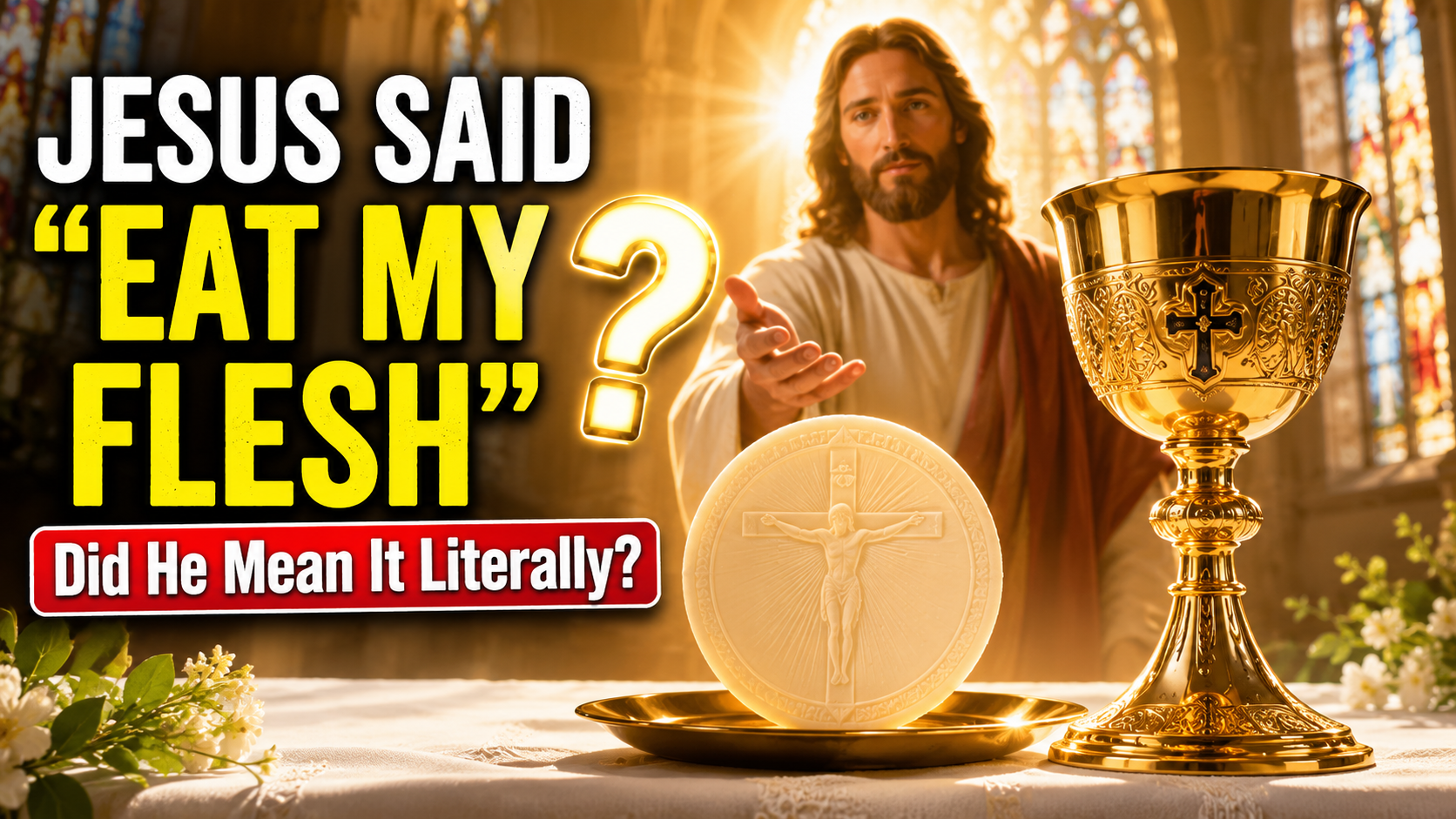
What if I told you that two thousand years ago, a group of grown men, men who had left everything to follow Jesus, heard something so shocking that many of them walked away and never came back? It wasn’t a rule. It wasn’t a warning. It was a promise. Jesus looked at them and said, “Unless you eat my flesh and drink my blood, you have no life in you.” No parable. No metaphor cushion. Just that. So today we’re answering the question millions of Christians have asked for two thousand years: did Jesus really mean it? And if He did, what does that mean for you, right now?
The Question
Catholics believe that during the Mass, ordinary bread and wine actually become the body and blood of Jesus Christ. Not a symbol. Not a nice reminder. The real thing, hidden under the appearance of bread and wine. It sounds impossible. But before you dismiss it, ask yourself: where did this belief even come from?
The Last Supper
Go back to the night before Jesus died. He’s with His closest friends. He takes bread, and He doesn’t say “this represents my body.” He says, “This is my body, given for you” (Luke 22:19). Then He takes the cup and says, “This is my blood of the covenant” (Mark 14:24). At the Last Supper, Jesus wasn’t speaking in riddles. He was fulfilling a promise He’d already made months earlier, when He stood in front of a crowd in Capernaum and said something that made people’s jaws drop.
The Bread of Life Discourse
In John chapter 6, Jesus tells the crowd that His flesh is real food and His blood is real drink. The people are horrified. They ask how this is even possible. And here’s the moment that changes everything: Jesus doesn’t soften His words. He doesn’t say, “Oh, I only meant it symbolically.” He repeats Himself, even more firmly. And the text tells us that many of His disciples left Him that day. Jesus let them walk away rather than take back what He said. Would He really let people abandon Him over a misunderstanding? Or was He telling the truth the whole time?
What the Early Church Believed
This isn’t a belief the Catholic Church invented centuries later. The earliest Christians, the ones taught directly by the apostles, wrote about receiving the true body and blood of Christ in the Eucharist. Long before church buildings, before councils, before the Bible was even fully assembled, this was already the faith of the early Christian community. It was never treated as optional or symbolic. It was treated as the source of life itself.
Why This Matters for Your Life
So why does this actually matter for your life today? Because if it’s true, if Jesus is truly present in the Eucharist, then every Mass is not just a ritual. It’s an encounter. It means you don’t have to imagine God is close. He is physically, truly present, waiting for you. Think about that the next time you feel distant from God, unseen, or forgotten. The Eucharist is Jesus saying, “I didn’t leave. I’m right here.” That truth can change how you walk into church this Sunday. Not out of obligation, but because Someone is actually waiting for you there.
A Message of Hope
And here’s the hope in all of this: you don’t need perfect understanding to receive perfect love. The apostles didn’t fully grasp it either. But they stayed. They trusted. And that same invitation is open to you, to come, not with all the answers, but with an open heart.
Prayer
Let’s pray together: Lord Jesus, thank You for loving us so completely that You give us Yourself. Increase our faith where we doubt, and help us recognize You in the Eucharist. Draw us closer to You, one Mass, one moment at a time. Amen.
Related Articles
 Common Mistakes Catholics Make During Mass and How to Avoid Them
 10 Things Every Catholic Should Know Before Receiving Holy Communion
 The Angelus Prayer Explained: Meaning, History and How to Pray It
 The Real Presence of Jesus in the Eucharist: What the Church Actually Teaches
 The Divine Mercy Chaplet Explained: Origins, Promises, and How to Pray It
 Why Does God Allow Suffering? A Catholic Reflection on Faith, Hope, and Trust