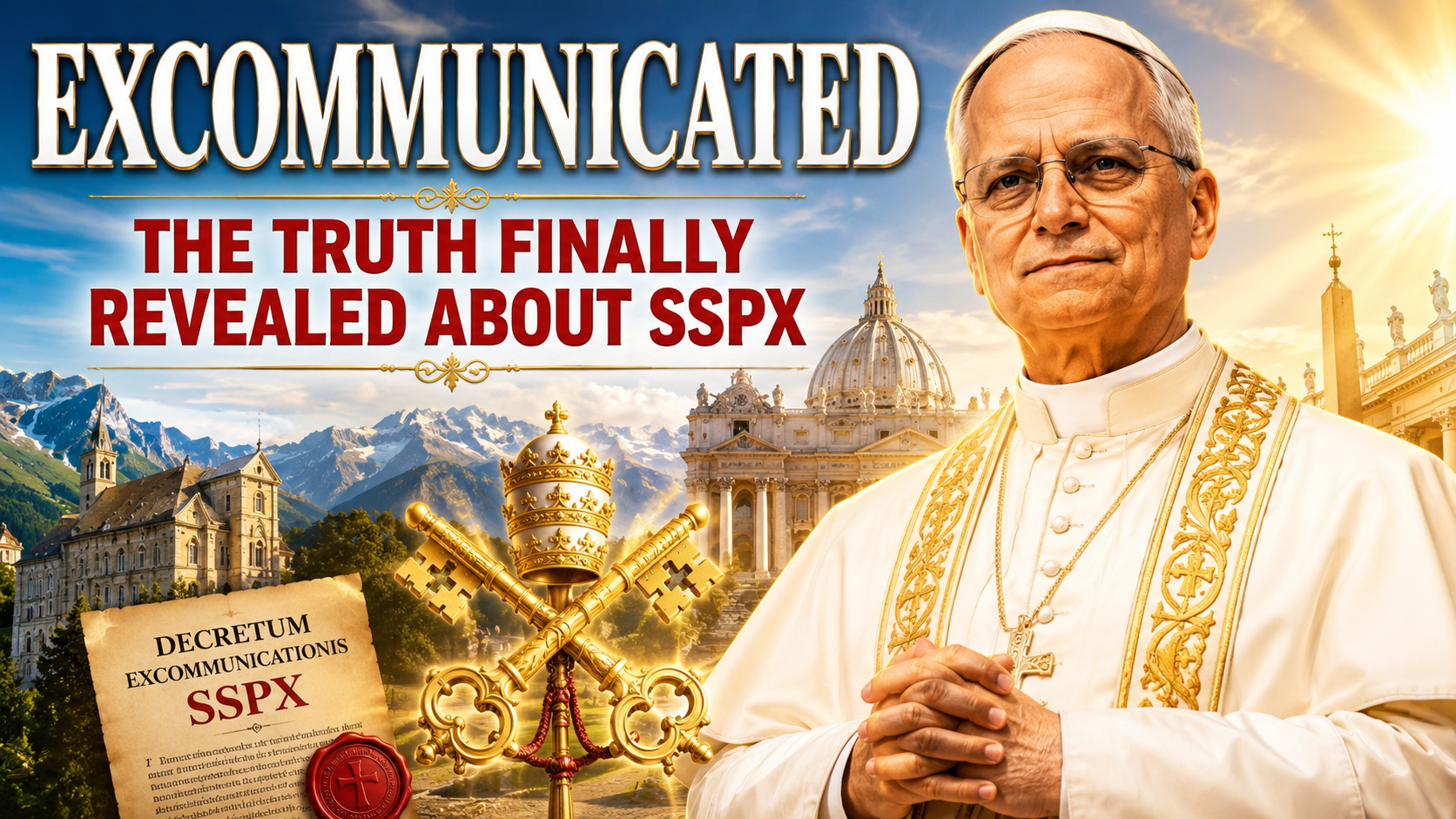
On July 2, 2026, the Vatican issued one of the strongest doctrinal declarations seen in decades. Under the leadership of Pope Leo XIV, the Holy See announced the excommunication of an entire Catholic group, including bishops, priests, and thousands of lay faithful who formally adhered to the Society of St. Pius X (SSPX).
This was not a quiet administrative decision. It was a public declaration intended to address a serious matter affecting the unity of the Catholic Church. The announcement immediately raised questions among Catholics around the world. What led to this decision? Why was such a severe measure taken? And what does it mean for ordinary Catholics today?
Understanding the events requires looking at the long and complex relationship between the Vatican and the Society of St. Pius X.
The Origins of the Society of St. Pius X
The Society of St. Pius X, commonly known as the SSPX, was founded in 1970 by Archbishop Marcel Lefebvre. The society was established in response to concerns about the reforms introduced following the Second Vatican Council.
Archbishop Lefebvre believed that certain post-conciliar changes departed from long-standing Catholic traditions. As a result, the SSPX became known for preserving traditional liturgical practices and expressing opposition to several aspects of the Council’s reforms.
For decades, the relationship between the Holy See and the SSPX remained difficult. There were periods of dialogue and hope for reconciliation, but there were also moments of significant conflict that prevented full communion from being restored.
The 1988 Episcopal Consecrations
The most serious rupture occurred in 1988.
Without receiving papal approval, Archbishop Lefebvre consecrated four bishops. According to Catholic canon law, consecrating bishops against the express will of the Pope constitutes a grave act because it directly challenges the Church’s visible unity and apostolic authority.
As a result, Rome immediately declared Archbishop Lefebvre and the newly consecrated bishops excommunicated.
This event marked one of the most significant divisions within the modern Catholic Church and deeply affected relations between the Vatican and the SSPX for many years.
Pope Benedict XVI’s Attempt at Reconciliation
More than two decades later, Pope Benedict XVI took an important step toward healing the division.
In 2009, he lifted the excommunications of the four bishops consecrated in 1988. His decision was not an endorsement of every position held by the SSPX. Instead, it was a pastoral gesture intended to encourage dialogue and create a path toward full reconciliation with the Catholic Church.
Many Catholics hoped this would become the beginning of a lasting reunion. Although conversations continued, complete communion was never fully restored.
The Events of July 2026
The situation reached a new turning point in July 2026.
On July 1, 2026, the Society of St. Pius X consecrated four new bishops in Écône, Switzerland, once again without papal authorization.
Before these consecrations took place, Pope Leo XIV had personally appealed to the society not to proceed. Just two days earlier, he warned that carrying out the consecrations without the approval of the Holy See would constitute “a sin of extreme gravity.”
Despite this direct appeal from the Pope, the consecrations went forward.
The following day, on July 2, 2026, the Vatican responded with a formal decree.
The Holy See declared the newly consecrated bishops, the bishops who performed the consecrations, and those who formally adhered to the group to be in schism and excommunicated. The decree reflected the Vatican’s judgment that the society had once again separated itself from full communion with the Catholic Church through deliberate disobedience regarding episcopal consecrations.
The decision represented one of the strongest disciplinary actions taken by the Vatican in recent decades.
Why Does the Church Take Unity So Seriously?
Many people naturally ask why the Catholic Church places such importance on unity.
The answer begins with Jesus Christ Himself.
In His prayer recorded in John 17:21, Jesus prayed to the Father that all His followers “may all be one… so that the world may believe.”
These words reveal that unity is not simply an organizational ideal. It is part of Christ’s own desire for His Church. Unity serves as a witness to the truth of the Gospel and reflects the communion that exists within the Holy Trinity.
Saint Paul reinforced this teaching in 1 Corinthians 1:10 when he urged Christians to agree with one another and avoid divisions within the Church.
Throughout Catholic history, unity has always been considered an essential mark of the Church. While disagreements and debates can occur, deliberate separation from communion with the successor of Saint Peter carries profound spiritual consequences.
Understanding Excommunication
The word “excommunication” often sounds harsh and final, but the Catholic Church understands it differently.
Excommunication is not intended as an act of revenge or condemnation. Rather, canon law describes it as a medicinal penalty.
Like medicine, its purpose is healing.
The goal is to awaken the conscience, encourage repentance, and invite a return to full communion with the Church. It serves as a serious reminder that actions affecting the unity of the Church have real spiritual consequences, while always leaving open the possibility of reconciliation.
The Church never stops praying for those who are separated from full communion.
Its deepest hope is always restoration rather than permanent exclusion.
What Does This Mean for Ordinary Catholics?
For most Catholics, these events happened thousands of miles away and may seem disconnected from everyday life.
Yet they offer an important spiritual lesson.
Unity within the Body of Christ is never something to be taken for granted. It requires humility, obedience, charity, and a willingness to remain connected even during difficult moments.
It is often easy to believe we are defending the truth while unintentionally allowing pride, resentment, or division to grow within our own hearts.
This news invites every Catholic to reflect personally.
Are there relationships in our lives that need healing?
Have we allowed disagreements to create unnecessary distance within our families, our parishes, or our communities?
Do we value unity enough to seek reconciliation when conflicts arise?
The Christian life is not simply about being correct. It is about holding truth and charity together.
Authentic Catholic faith never asks believers to choose between truth and unity. Instead, it calls them to embrace both faithfully.
A Message of Hope
Although this situation is serious, it is not without hope.
The history of the Catholic Church includes periods of division, schism, and eventual reconciliation. Throughout the centuries, individuals and entire communities have returned to full communion through repentance, dialogue, and the grace of God.
Canon law may establish penalties when necessary, but God’s mercy always remains available to those who sincerely seek it.
No division is greater than the healing power of Christ.
The Church continues to pray that every separation may one day be overcome and that all Christians may once again share complete unity in faith, worship, and communion.
A Prayer for Unity
Lord Jesus Christ, You prayed that all Your followers would be one.
Heal every division within Your Church. Grant wisdom to her leaders, courage to those who have wandered, and humility to every believer. Help us always to seek truth with charity and to choose unity over pride.
May Your Holy Spirit guide Your Church toward greater holiness, deeper faith, and lasting peace.
Amen.
Related Articles
 The Angelus Prayer Explained: Meaning, History and How to Pray It
 Common Mistakes Catholics Make During Mass and How to Avoid Them
 10 Things Every Catholic Should Know Before Receiving Holy Communion
 The Miraculous Medal Devotion: History, Meaning, and Spiritual Benefits
 What Every Catholic Family Should Have in Their Home for Spiritual Growth
 How the Blessed Virgin Mary Teaches Us to Trust God Completely