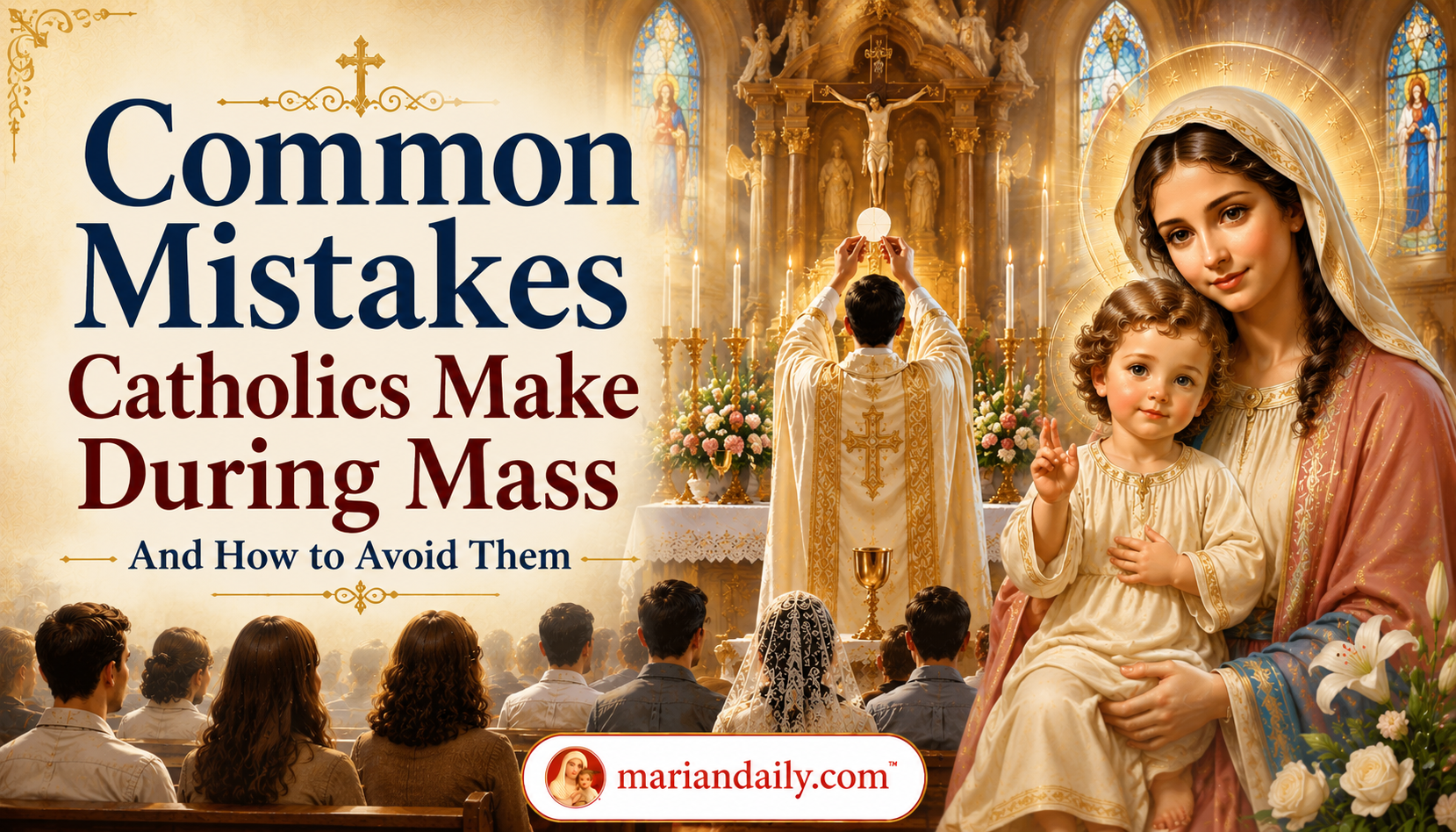
The Holy Mass is the highest form of prayer in the Catholic Church. It is not simply a weekly gathering, a religious routine, or a spiritual obligation to complete. At every Mass, Catholics are invited to enter more deeply into the mystery of Christ’s sacrifice, hear the Word of God, and receive the Lord in the Holy Eucharist.
Because the Mass is so sacred, the way we participate matters. Many Catholics sincerely love God but may still fall into habits that weaken attention, reverence, and spiritual preparation. These mistakes are usually not done out of disrespect. Often, they happen because people were never properly taught, became distracted over time, or forgot the deeper meaning of what takes place at Mass.
The purpose of this article is not to judge anyone. Rather, it is a gentle reminder to help Catholics participate in the Mass with greater faith, reverence, and love.
Scripture Foundation
“Do this in remembrance of me.” — Luke 22:19
At the Last Supper, Jesus instituted the Eucharist and gave the Church a sacred command. The Mass is deeply rooted in this mystery. It is the memorial of Christ’s sacrifice, made present sacramentally for the salvation of the faithful.
When Catholics understand this, the Mass becomes more than an obligation. It becomes an encounter with Jesus Christ.
1. Arriving Late Without Serious Reason
One common mistake Catholics make is arriving late to Mass casually or habitually.
Sometimes lateness cannot be avoided. Family emergencies, traffic, illness, weather, children, or unexpected circumstances can happen. But when arriving late becomes a regular habit without a serious reason, it can weaken our spiritual preparation.
The opening parts of the Mass are important. The entrance, greeting, penitential act, Gloria when prescribed, and opening prayer help prepare the faithful to enter into worship. Missing these parts can make it harder to participate attentively.
A better practice is to arrive at least ten minutes early. This gives time to quiet the mind, pray, prepare intentions, and become aware that we are entering the house of God.
Before Mass begins, a simple prayer can help:
“Lord, prepare my heart to worship You with faith and reverence.”
2. Treating the Church Like an Ordinary Meeting Place
Another common mistake is treating the church as if it were only a hall, auditorium, or social gathering space.
Friendship and community are important in parish life, but the church itself is a sacred place. It is a place of prayer, worship, and reverence. In many Catholic churches, the Blessed Sacrament is present in the tabernacle. This means Christ is truly present in a unique and sacred way.
Loud talking, unnecessary conversations, casual behavior, and distractions before Mass can disturb others who are trying to pray. It can also make our own hearts less prepared.
A better practice is to greet people warmly outside the church or after Mass, while keeping the church interior prayerful and respectful.
Silence before Mass is not empty. It is a space where the soul can listen to God.
3. Forgetting to Genuflect or Bow Reverently
Many Catholics enter the pew quickly without making any gesture of reverence.
Traditionally, Catholics genuflect toward the tabernacle when the Blessed Sacrament is present. If genuflecting is physically difficult, a respectful bow is appropriate. These gestures are not empty customs. They express faith in the presence of God.
Reverence teaches the body to pray. When we genuflect or bow with attention, we remind ourselves that we are not entering an ordinary place. We are entering sacred worship.
The key is not to perform gestures mechanically, but to do them consciously and lovingly.
A simple interior prayer while genuflecting can be:
“Jesus, I adore You and I come before You with love.”
4. Being Physically Present but Mentally Distracted
Many people attend Mass, but their minds are elsewhere.
They may be thinking about work, family problems, messages, errands, money worries, or plans for the day. This is a very human struggle. Distraction happens to everyone. But if we never try to refocus, we miss the spiritual richness of the Mass.
The Mass invites the whole person: body, mind, heart, and soul. Active participation does not mean doing many external things. It means praying with attention, listening carefully, responding sincerely, and uniting our hearts to Christ.
When distractions come, gently return to the Mass. Listen to the readings. Watch the gestures of the priest. Pray the responses slowly. Offer your worries to God at the altar.
A helpful practice is to choose one intention before Mass begins and carry it prayerfully throughout the liturgy.
5. Not Listening Carefully to the Readings
The Liturgy of the Word is an essential part of the Mass.
Sometimes Catholics allow the readings to pass by without attention. They may hear the words but not truly listen. Yet through Scripture, God speaks to His people.
The First Reading, Psalm, Second Reading when included, Gospel Acclamation, and Gospel all prepare the faithful for the Eucharist. The homily then helps explain the Word of God and apply it to Christian life.
A better practice is to read the Sunday readings before attending Mass. This helps the mind recognize the message when it is proclaimed. Even reading the Gospel once before Mass can make a difference.
During the readings, ask quietly:
“Lord, what are You teaching me today?”
6. Receiving Holy Communion Without Proper Preparation
Holy Communion is not a casual ritual. It is the reception of Jesus Christ Himself in the Eucharist.
One serious mistake is approaching Holy Communion without proper spiritual preparation. Catholics should examine their conscience and be aware of the Church’s teaching on receiving Communion worthily.
The Church teaches that anyone conscious of mortal sin should first receive the Sacrament of Reconciliation before receiving Holy Communion. This is not meant to push people away from God, but to help them receive the Eucharist with a heart restored to grace.
Preparation also includes the Eucharistic fast, reverence, faith, and prayer.
Before receiving Communion, Catholics should remember whom they are receiving. The response “Amen” means an act of faith. It means we believe that this is truly the Body of Christ.
7. Leaving Immediately After Communion
Another common mistake is leaving Mass immediately after receiving Holy Communion.
There may be rare situations where someone must leave early for a serious reason. But leaving habitually after Communion can show a misunderstanding of the Mass.
After receiving Holy Communion, the faithful are invited into a sacred moment of thanksgiving. Christ has come to dwell within us sacramentally. These moments are precious.
Instead of rushing out, remain in prayer. Thank Jesus. Offer your family, struggles, needs, and hopes to Him. Ask for the grace to live faithfully.
The Mass does not end at Communion. It continues through the Prayer after Communion, final blessing, and dismissal. The dismissal sends the faithful out to live the Gospel.
8. Dressing Without Considering the Sacredness of Mass
Clothing can vary according to culture, climate, work schedules, and personal circumstances. The Church does not require everyone to dress expensively or formally.
However, one mistake is dressing for Mass with no thought of reverence at all.
The way we dress can express respect for the sacredness of the occasion. We are not attending an ordinary event. We are participating in the Holy Sacrifice of the Mass.
This does not mean judging others by appearance. Some people come to church directly from work, travel, caregiving, or difficult circumstances. Charity must always come first.
But when we have a choice, modest, respectful, and appropriate clothing is a good way to honor God and remind ourselves of the dignity of worship.
9. Using the Phone Unnecessarily
Phones are one of the biggest modern distractions during Mass.
Some people use phones for legitimate reasons, such as reading the Mass readings, following prayers, managing health needs, or urgent family situations. But casual texting, scrolling, checking notifications, or browsing during Mass weakens attention and can distract others.
A better practice is to silence the phone before entering church. If using a phone for readings or prayers, keep it focused only on that purpose.
The Mass deserves our full attention. For one hour, we can give God our heart without unnecessary digital noise.
A simple habit helps: before entering the church, silence the phone and say, “Lord, this time is Yours.”
10. Not Participating in the Responses and Prayers
Some Catholics remain silent throughout Mass, even when the congregation is invited to respond.
The responses, acclamations, Creed, penitential prayers, and hymns are not filler. They are part of the prayer of the Church. When Catholics respond with faith, they participate more fully in the liturgy.
This does not mean everyone must sing loudly or perfectly. But the faithful should participate according to their ability.
Saying “Lord, have mercy,” “Thanks be to God,” “Glory to You, O Lord,” and “Amen” with attention can deepen participation.
The Mass is not a performance watched from a distance. It is worship offered by Christ and His Church.
11. Forgetting the Importance of Silence
Silence is an important part of Catholic worship.
Some people feel uncomfortable with silence and try to fill every moment with movement, talking, or distraction. But sacred silence allows the Word of God to enter the heart.
There are moments in the Mass where silence has special value: before Mass, after the readings, after the homily, after Communion, and during personal prayer.
Silence helps us become aware of God’s presence. It allows the heart to respond, not just the lips.
A reverent Catholic learns not only how to speak to God, but also how to be still before Him.
12. Judging Others During Mass
One hidden mistake is spending Mass judging other people.
It is easy to notice who came late, who is dressed differently, whose child is crying, who is distracted, or who does not know the responses. But this attitude can damage our own prayer.
Mass is not the time to compare ourselves with others. It is the time to stand humbly before God.
Parents with young children, elderly people, people with disabilities, newcomers, converts, and those returning to the Church may all participate differently. Charity is essential.
Instead of judging, pray for others. If someone seems distracted or struggling, quietly ask God to bless them.
A humble heart receives more grace than a critical heart.
13. Thinking Sunday Mass Is Only an Obligation
Catholics are obliged to attend Mass on Sundays and holy days of obligation, unless excused for serious reasons. But reducing Mass only to an obligation can make it feel like a burden.
Sunday Mass is a gift before it is a duty. It is the weekly encounter with the risen Christ. It forms Catholic identity, nourishes the soul, strengthens the family, and unites the faithful with the whole Church.
When Catholics understand the meaning of Mass, obligation becomes love.
We do not go to Mass simply because we have to. We go because Christ is there, waiting to feed us with His Word and His Body.
How to Avoid These Mistakes
Avoiding these mistakes does not require perfection. It requires intention.
Begin with small changes:
- Arrive a few minutes earlier.
- Pray before Mass begins.
- Listen carefully to the readings.
- Receive Holy Communion with reverence.
- Stay until the final blessing.
- Spend time in thanksgiving after Communion.
- Keep the phone silent.
- Practice charity toward others.
- Learn more about the meaning of the Mass.
Spiritual growth happens gradually. Every Mass is an opportunity to begin again.
Reflection
The Holy Mass is one of the greatest treasures of the Catholic faith. Through the Mass, the faithful are nourished by the Word of God, united with Christ’s sacrifice, and strengthened through the Holy Eucharist.
Most mistakes during Mass come from distraction, habit, lack of formation, or forgetfulness. They can be corrected with humility and love.
The goal is not to become anxious or scrupulous. The goal is to become more attentive, reverent, and spiritually awake.
When Catholics participate in Mass with faith, the liturgy becomes a school of holiness. It teaches us to listen, adore, repent, receive, give thanks, and go forth as disciples of Christ.
Each Mass is a sacred invitation. Let us respond with love.
Closing Prayer
Lord Jesus Christ,
Thank You for the gift of the Holy Mass.
Help us to participate with faith, reverence, attention, and love. Forgive us for the times we have been distracted, careless, or spiritually unprepared.
Teach us to listen to Your Word, honor Your presence, receive the Eucharist worthily, and live the grace of the Mass in our daily lives.
May every Mass draw us closer to You and make us more faithful witnesses of Your love.
Amen.
Related Articles
 The Angelus Prayer Explained: Meaning, History and How to Pray It
 10 Things Every Catholic Should Know Before Receiving Holy Communion
 The Divine Mercy Chaplet Explained: Origins, Promises, and How to Pray It
 The Hidden Power of Daily Prayer: Small Habits That Change the Soul
 The Difference Between Happiness and Joy: A Christian Perspective
 What Every Catholic Family Should Have in Their Home for Spiritual Growth