What if a single piece of cloth could hold the fingerprint of the Resurrection itself?
For more than a century, the Shroud of Turin has fascinated scientists, historians, believers, and skeptics alike. It is one of the most studied religious artifacts in history, yet it continues to resist easy explanation.
The Vatican has never officially declared the Shroud to be the authentic burial cloth of Jesus Christ. At the same time, the Church has never stopped encouraging careful study of this remarkable relic. Instead of rushing to conclusions, it has welcomed ongoing scientific investigation while inviting the faithful to reflect on the mystery it presents.
In this article, we will explore what makes the Shroud of Turin so extraordinary, why the Catholic Church approaches it with caution, and what this mysterious cloth can teach us about Christ’s suffering, His Resurrection, and our own journey of faith.
The Mystery of the Shroud of Turin
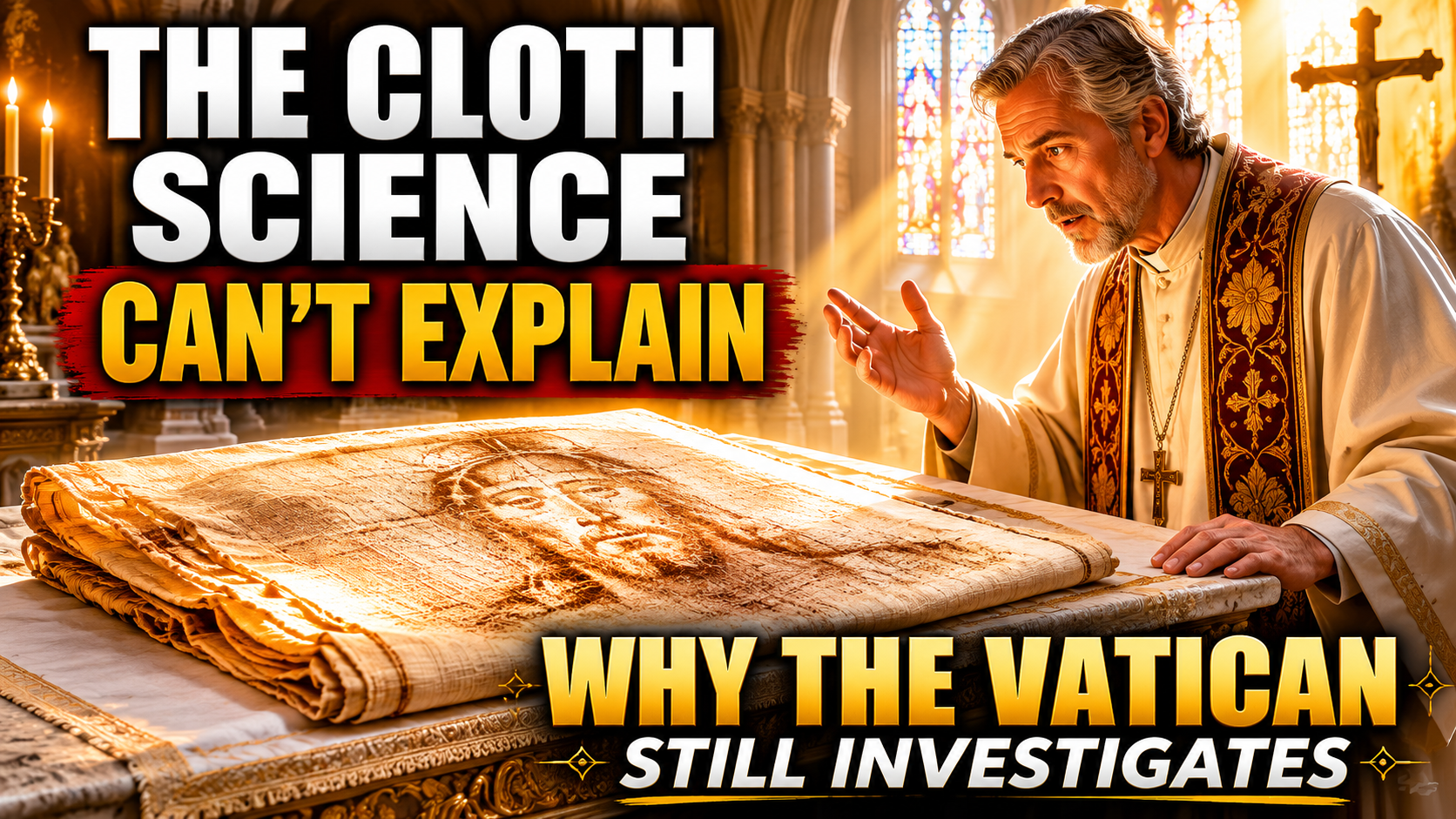
At first glance, the Shroud of Turin appears to be an ordinary piece of ancient linen. However, a closer look reveals something astonishing. Faintly visible on the cloth is the image of a man who appears to have suffered intense physical abuse before death.
The figure bears wounds that closely match the biblical accounts of Jesus’ crucifixion. His body shows signs of scourging. There are wounds around the head consistent with a crown of thorns. His wrists and feet appear pierced, and there is evidence of a wound in his side.
For many Christians, these details strongly suggest that the cloth may have wrapped the body of Jesus after His crucifixion.
The Gospel of John records what the disciples discovered on Easter morning.
“Then Simon Peter came, following him, and went into the tomb. He saw the linen cloths lying there, and the face cloth, which had been on Jesus’ head, not lying with the linen cloths but folded up in a place by itself.” (John 20:6–7)
This passage has inspired countless believers to consider whether the Shroud of Turin could be connected to the burial cloths mentioned in Scripture.
Why Scientists Continue to Study the Shroud
One reason the Shroud has remained a subject of worldwide interest is that many of its physical characteristics remain difficult to explain.
Researchers have attempted to reproduce the image using paint, pigments, dyes, scorching techniques, and even advanced radiation experiments. Despite decades of investigation, no method has successfully duplicated every unique feature found on the cloth.
Scientists have observed that the image exists only on the outermost microscopic fibers of the linen. There are no visible brushstrokes. No significant pigment residue has been identified that fully explains the image.
Even more remarkable, digital analysis has shown that the image contains three dimensional information. When processed using specialized imaging technology, the brightness of different areas corresponds to varying distances from a body, creating an unexpected three dimensional effect that ordinary paintings do not possess.
Whether these characteristics ultimately point to a natural explanation or something beyond current scientific understanding remains an open question.
Why the Catholic Church Has Not Declared the Shroud Authentic
Many people wonder why the Catholic Church has not officially proclaimed the Shroud of Turin to be the genuine burial cloth of Christ.
The answer reveals something important about the Church itself.
The Catholic Church approaches extraordinary claims with great care. Rather than making declarations without sufficient evidence, the Church encourages continued study by historians, chemists, physicists, textile experts, and forensic investigators.
This careful approach reflects confidence rather than uncertainty. Authentic faith does not fear honest investigation.
Instead of requiring Catholics to believe the Shroud is authentic, the Church presents it as a sacred image that can inspire prayer and meditation regardless of whether its precise origin is ever conclusively proven.
The mystery remains open to scientific research while continuing to encourage spiritual reflection.
More Than a Scientific Puzzle
Although scientific questions often dominate discussions about the Shroud, they are not its deepest significance.
The image on the cloth portrays profound suffering.
Every visible wound recalls the Passion of Christ described throughout the Gospels. The marks of scourging, the wounds of crucifixion, the injuries to the head, and the pierced side all remind believers of the price Jesus willingly paid for humanity’s salvation.
The prophet Isaiah wrote centuries before Christ’s birth:
“But he was pierced for our transgressions, he was crushed for our iniquities; the punishment that brought us peace was on him, and by his wounds we are healed.” (Isaiah 53:5)
Whether viewed as a historical relic or as a sacred icon, the Shroud invites us to contemplate the immense love revealed through Christ’s suffering.
It reminds us that His Passion was never meaningless. Every wound speaks of mercy, forgiveness, and redemption.
The Resurrection Changes Everything
The story of the Shroud ultimately points beyond suffering.
Christianity does not end with the Cross. It reaches its fulfillment in the empty tomb.
The burial cloth, whatever its exact history may be, directs our attention toward the central truth of the Gospel: Jesus Christ conquered death through His Resurrection.
This message continues to offer hope to every generation.
Many people carry hidden wounds that others never see. Some struggle with grief. Others carry disappointment, loneliness, anxiety, or unanswered prayers.
The Resurrection reminds us that suffering is never the final chapter for those who place their trust in Christ.
Even when life feels like a sealed tomb, God may already be preparing new life beyond what we can presently understand.
Trusting God in the Midst of Mystery
Not every question about the Shroud has been answered.
In fact, some mysteries remain unresolved after decades of careful research.
Yet the Church continues both to study and to believe.
This balance offers an important lesson for every Christian.
Faith is not the absence of questions. Rather, it is the decision to trust God even when complete understanding remains beyond our reach.
Just as scholars continue examining the Shroud with intellectual honesty, believers continue following Christ with confidence.
Mystery does not weaken faith. It often deepens it.
What the Shroud of Turin Means for Us Today
Whether you one day stand before the Shroud in Turin or only see photographs of it, its greatest message remains unchanged.
It points us toward Jesus Christ.
It reminds us that love willingly entered suffering.
It reminds us that death did not have the final word.
It reminds us that our own wounds are not wasted when placed in God’s hands.
The greatest mystery is not simply an ancient piece of linen. The greatest mystery is a Savior who transforms suffering into redemption and death into everlasting life.
That is the hope Christians continue to proclaim throughout the world.
Conclusion
The Shroud of Turin remains one of history’s greatest mysteries, inviting both scientific investigation and spiritual reflection. While the Church wisely avoids making definitive claims beyond the available evidence, it encourages believers to look beyond the cloth itself and focus on the One it portrays.
The message of Christ’s Passion and Resurrection continues to change lives today just as it did two thousand years ago.
When life brings uncertainty, unanswered questions, or painful seasons, remember that God often works most deeply in places we cannot yet fully understand.
Like the empty tomb, hope can emerge where we least expect it.
Prayer
Lord Jesus, thank You for entering fully into human suffering and rising again in glorious victory. Help us trust You even when we cannot understand every mystery before us. Strengthen our faith, deepen our hope, and remind us that our story, like Yours, does not end in the tomb. Amen.
Call to Action
If this reflection strengthened your faith, consider sharing it with someone who may need hope today. Subscribe for more inspiring Catholic articles that explore Scripture, Church history, and the enduring truths of our faith. We’d also love to hear from you in the comments. What mystery of the Catholic faith would you like to explore next?
Related Articles
 The Real Presence of Jesus in the Eucharist: What the Church Actually Teaches
 SSPX Excommunication 2026: Vatican Decision Explained
 Jesus’ Secret Promise: Why This 1 Prayer Changes Everything
 What Happens When You Die? Catholic Teaching
 Common Mistakes Catholics Make During Mass and How to Avoid Them
 What Every Catholic Family Should Have in Their Home for Spiritual Growth