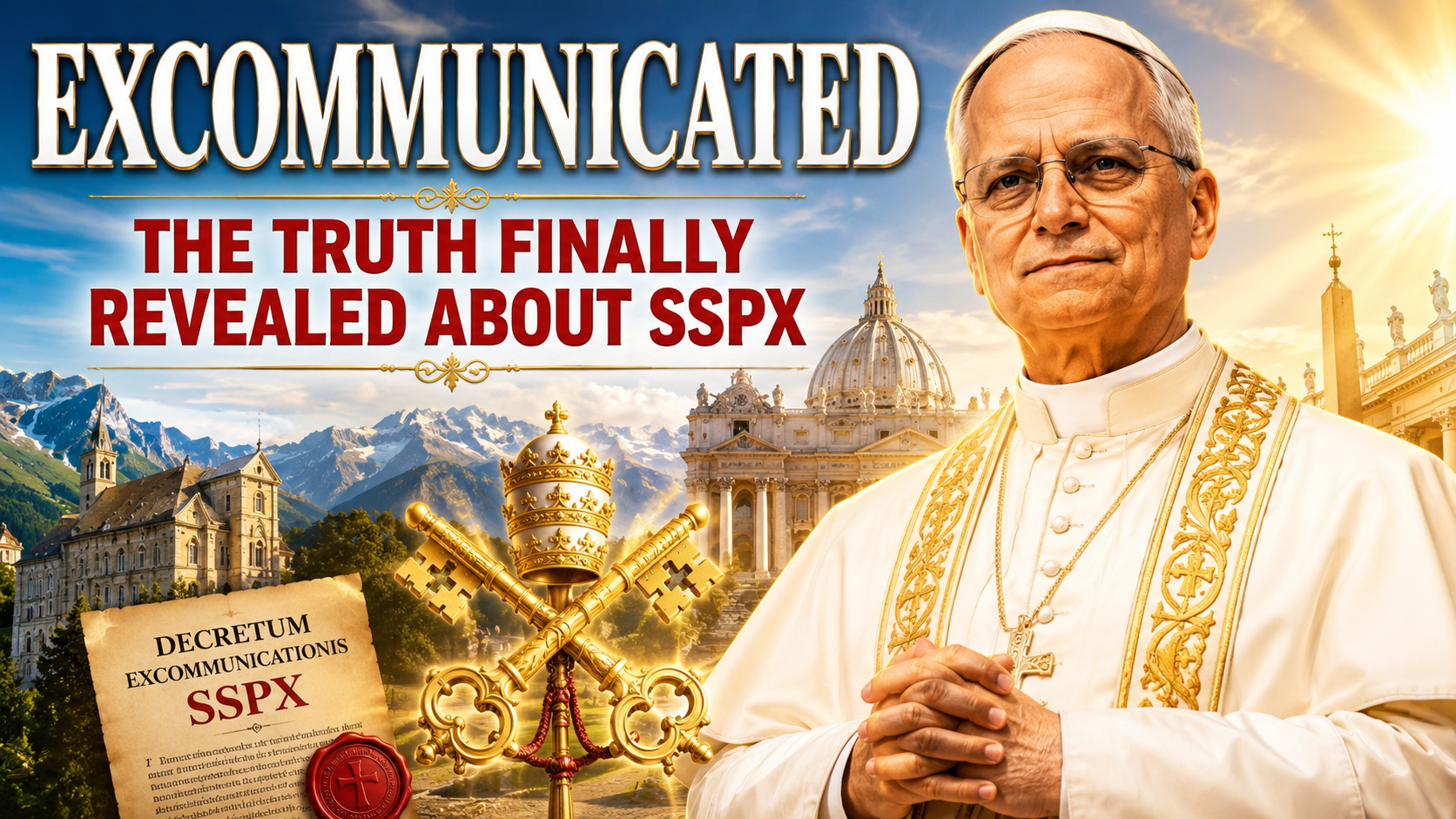
What exactly happened in the SSPX excommunication 2026 controversy, and why has it drawn worldwide attention among Catholics? On July 2, 2026, the Holy See issued a decree following the consecration of four new bishops for the Society of St. Pius X at Écône, Switzerland, without a papal mandate.
The decision followed years of tension, dialogue, and attempted reconciliation between Rome and the Society of St. Pius X, commonly known as the SSPX. It also reopened questions that have remained unresolved since the episcopal consecrations of 1988.
This article explains the history behind the SSPX excommunication 2026 decision, what the Vatican actually declared, why Catholic unity matters, and what ordinary Catholics can learn from this difficult moment in Church history.
SSPX Excommunication 2026: Understanding the Society of St. Pius X
The story of the SSPX excommunication 2026 decision begins with the Society’s history.
Archbishop Marcel Lefebvre founded the Society of St. Pius X in 1970. The organization emerged during a period of major change in the Catholic Church following the Second Vatican Council.
The SSPX became particularly known for its attachment to traditional Catholic liturgy and its criticism of certain developments associated with the Council and the post-conciliar period.
However, the central issue between the SSPX and the Holy See has never concerned only liturgical preferences. Instead, the deeper dispute involves questions of Church authority, the interpretation of the Second Vatican Council, and the relationship between the SSPX and the Pope.
For decades, therefore, Rome and the SSPX have experienced a complicated relationship. At different times, both sides have pursued dialogue and reconciliation. Nevertheless, full canonical reconciliation has not been achieved.
The SSPX excommunication 2026 decision must be understood within this much longer history.
The 1988 Episcopal Consecrations and the First Major Rupture
The most important earlier event occurred on June 30, 1988.
Archbishop Lefebvre consecrated four bishops without a pontifical mandate. The consecrations took place despite the Holy See’s opposition.
This action created a major rupture between the SSPX and Rome. The four bishops were Bernard Fellay, Bernard Tissier de Mallerais, Richard Williamson, and Alfonso de Galarreta.
The Vatican declared that the bishops involved had incurred excommunication. The dispute also raised a much broader question: Can a Catholic bishop consecrate another bishop without authorization from the Pope?
Catholic canon law places great importance on the Pope’s role in episcopal appointments and consecrations. Therefore, an unauthorized episcopal consecration can become a serious matter concerning Church unity and ecclesial authority.
The events of 1988 shaped the relationship between the SSPX and the Vatican for decades.
Pope Benedict XVI and the 2009 Remission of Excommunication
The history of the SSPX excommunication 2026 decision also includes an important moment of reconciliation.
In January 2009, Pope Benedict XVI approved the remission of the excommunication of the four bishops consecrated in 1988. His decision aimed to remove a major obstacle to further dialogue.
However, remission of the excommunication did not mean that the SSPX had automatically entered full communion with the Catholic Church.
In his 2009 letter to the world’s bishops, Pope Benedict emphasized that further steps remained necessary. He hoped the gesture would encourage deeper dialogue and eventually lead to full reconciliation with the Church.
The Vatican’s 2009 action therefore represented a gesture toward healing rather than an endorsement of every position held by the SSPX.
Consequently, the relationship remained unresolved.
The SSPX continued to operate outside full canonical regularity. At the same time, discussions between representatives of the society and the Holy See continued over theological and ecclesial questions.
What Happened at Écône in July 2026?
The immediate events behind the SSPX excommunication 2026 decision took place in Switzerland.
On July 1, 2026, four priests were consecrated as bishops at Écône, the SSPX’s headquarters. Bishops Alfonso de Galarreta and Bernard Fellay performed the consecrations.
The four new bishops were Pascal Schreiber, Michael Goldade, Michel Poinsinet de Sivry, and Marc Hanappier.
The consecrations took place without a papal mandate. According to Vatican reporting, Pope Leo XIV had appealed directly to the SSPX not to proceed. His June 29 letter came just two days before the scheduled ceremony and urged the society not to carry out the consecrations.
Nevertheless, the ceremony went ahead.
The SSPX leadership presented the consecrations as necessary for the society’s future and continuity. However, the Holy See viewed the action differently.
From the Vatican’s perspective, the consecrations constituted an act of a schismatic nature because they occurred without a papal mandate and against the expressed will of the Supreme Pontiff.
The next day, July 2, the Dicastery for the Doctrine of the Faith published its decree.
What Did the Vatican Actually Declare?
The SSPX excommunication 2026 decree requires careful reading.
The Vatican did not simply declare every person connected with the SSPX automatically excommunicated.
Instead, the decree identified specific canonical consequences.
The bishops involved
The decree states that Bishops Alfonso de Galarreta and Bernard Fellay, who performed the consecrations, incurred excommunication.
The four newly consecrated bishops also incurred excommunication.
The decree described the episcopal consecrations as an “act of a schismatic nature” because they occurred without a papal mandate and against the Pope’s will.
SSPX sacred ministers
The explanatory note accompanying the decree states that sacred ministers belonging to the SSPX are in schism and are subject to the canonical penalty prescribed by Church law.
It also warns that the sacraments they administer are illicit. The document specifically addresses the validity of confession and marriages involving SSPX ministers.
Lay faithful
The situation involving lay Catholics requires greater precision.
According to the Vatican’s explanatory note, lay faithful who formally adhere to the SSPX can be considered schismatic and excommunicated under the conditions established in the 1996 explanatory note of the Pontifical Council for Legislative Texts.
Therefore, the statement that “thousands of lay Catholics were automatically excommunicated” oversimplifies the Vatican’s actual position.
The canonical distinction matters.
The SSPX excommunication 2026 decree addresses formal adherence and specific canonical circumstances. It does not mean that every Catholic who has ever attended an SSPX Mass automatically incurred excommunication.
Why Does Catholic Church Unity Matter?
Why does the Catholic Church take unity so seriously?
The answer begins with Jesus Christ.
In John 17:21, Jesus prays that His followers “may all be one.” This prayer appears during His final discourse before His Passion.
The Church understands this prayer as a profound call to Christian unity. Unity, therefore, is not merely an administrative arrangement.
Instead, it points toward the communion Christ desires for His disciples.
Saint Paul expresses a similar concern in 1 Corinthians 1:10. He urges Christians to avoid divisions and to remain united in mind and purpose.
Likewise, Catholic teaching recognizes visible unity as an essential dimension of the Church.
The Catholic Church teaches that this unity includes communion in faith, the sacraments, and Church governance under the Pope and the bishops in communion with him.
Therefore, disputes involving episcopal authority can have consequences that reach far beyond individual disagreements.
What Does Excommunication Mean in Catholic Teaching?
The word “excommunication” can sound like a final rejection.
However, Catholic canon law treats excommunication as a medicinal penalty. Its purpose is not revenge.
Instead, the Church intends such penalties to encourage repentance and restoration.
In other words, the goal is healing.
Excommunication does not mean that God stops loving a person. Nor does it mean that the Church abandons the hope of reconciliation.
The Catholic understanding of discipline always includes the possibility of conversion.
Consequently, the SSPX excommunication 2026 decision should not be understood as a declaration that reconciliation can never happen.
The Vatican’s own explanatory note emphasizes that the Church remains ready to welcome those who wish to return to full communion.
The Biblical Meaning of Unity
The SSPX excommunication 2026 controversy also invites Catholics to reflect on Scripture.
Jesus prayed for unity
In John 17:21, Jesus prayed that His disciples would be one.
This passage reminds Christians that unity belongs to Christ’s own prayer for His Church. Therefore, believers should never treat division as something insignificant.
Saint Paul warned against division
In 1 Corinthians 1:10, Saint Paul urges the Christian community to avoid divisions.
His message remains relevant today. Disagreements can arise in families, parishes, dioceses, and Catholic communities.
However, Christians must approach those disagreements with truth, humility, and charity.
The Church is one Body
Saint Paul also describes the Church as the Body of Christ in 1 Corinthians 12.
This image highlights the importance of communion. Each member has a role, yet the members belong to one body.
Therefore, Catholic unity involves more than agreeing on every personal preference. It involves remaining connected to Christ and His Church.
What Can Catholics Learn From the SSPX Excommunication 2026?
The SSPX excommunication 2026 decision offers several spiritual lessons for Catholics today.
1. Unity requires humility
Catholics can disagree about many matters. Nevertheless, humility remains essential.
We should ask whether our opinions strengthen communion or deepen division.
2. Truth and charity belong together
Catholic faith does not require believers to abandon truth for the sake of peace.
At the same time, defending truth should never become an excuse for hatred or pride.
Therefore, Catholics should seek both truth and charity.
3. Reconciliation requires patience
The history of the SSPX demonstrates how difficult reconciliation can become.
The relationship between Rome and the SSPX has lasted for decades. Yet dialogue has continued.
That history reminds Catholics that healing often takes time.
4. Personal conflicts also matter
The lesson applies beyond Church politics.
For example, consider your own family.
Is there someone you have stopped speaking with because of an old disagreement?
Have anger or pride created distance?
Could a simple act of forgiveness begin the healing process?
Likewise, parish disagreements can become serious when people stop listening to one another.
The Christian response should always seek peace without abandoning truth.
How Catholics Can Respond Today
The events surrounding the SSPX excommunication 2026 controversy can lead Catholics toward practical action.
Here are four simple steps:
- Pray for the unity of the Church.
- Avoid spreading unverified claims about the SSPX or the Vatican.
- Learn what the Catholic Church actually teaches before forming strong opinions.
- Practice reconciliation in your own family and parish community.
Moreover, Catholics should remain faithful to prayer and the sacraments.
The Church’s unity is not protected only by official documents. It also grows through everyday acts of humility, forgiveness, patience, and charity.
A Message of Hope
The SSPX excommunication 2026 decision is undoubtedly serious.
However, Catholics should not respond with despair.
Church history contains painful periods of division. Yet history also shows that reconciliation remains possible.
The Vatican’s action does not close the door to repentance. Instead, Catholic discipline continues to hold open the possibility of restoration.
God’s mercy remains greater than human division.
Therefore, Catholics can pray that the current separation will eventually lead toward renewed dialogue and full communion.
The Church’s deepest hope is not punishment. It is unity.
The SSPX excommunication 2026 controversy should ultimately remind Catholics that Christ continues to call His followers toward holiness, truth, humility, and communion.
Frequently Asked Questions About SSPX Excommunication 2026
What is the SSPX excommunication 2026 decision?
The SSPX excommunication 2026 decision followed the July 1 consecration of four new SSPX bishops at Écône without a papal mandate. The Vatican declared that the bishops involved incurred excommunication and described the act as schismatic in nature.
Did the Vatican excommunicate every SSPX member?
No. The SSPX excommunication 2026 decree does not simply state that every person associated with the society automatically incurred excommunication. It specifically addresses sacred ministers and lay faithful who formally adhere to the SSPX under the canonical conditions cited by the Vatican.
Why did the SSPX consecrate four bishops?
The SSPX presented the consecrations as necessary for the continuity and future of the society. However, the Vatican opposed the action because the consecrations took place without a papal mandate.
What happened in 1988 between the SSPX and Rome?
In 1988, Archbishop Marcel Lefebvre consecrated four bishops without a papal mandate. The action led to excommunications and became the central rupture in the relationship between the SSPX and the Holy See.
Did Pope Benedict XVI reconcile the SSPX with the Catholic Church?
No. In 2009, Pope Benedict XVI remitted the excommunication of the four bishops consecrated in 1988. However, he also emphasized the need for further steps toward full communion.
What does excommunication mean in Catholic teaching?
Excommunication is a serious medicinal penalty intended to encourage repentance and restoration. It does not mean that the Church stops praying for the person or that reconciliation becomes impossible.
Can SSPX members return to full communion?
Yes. The Catholic Church continues to leave open the possibility of reconciliation and restoration to full communion. The Vatican’s July 2026 explanatory note specifically speaks of welcoming those who wish to return.
Why is Church unity important to Catholics?
Catholics value unity because Jesus prayed that His followers would be one. The Church also understands communion with the Pope and bishops in communion with him as an essential part of Catholic unity.
Conclusion: A Call to Unity and Hope
The SSPX excommunication 2026 decision represents another painful chapter in the long and complicated relationship between the Society of St. Pius X and the Holy See.
Yet the story is about more than canonical penalties.
It is also about the Catholic understanding of unity, authority, obedience, reconciliation, and mercy.
The events at Écône remind Catholics that Church unity requires humility and charity. At the same time, they show that serious disagreements cannot simply be ignored.
Nevertheless, Catholics should respond with prayer rather than hatred.
The Church continues to hope for reconciliation. Therefore, let every Catholic pray for the Pope, the bishops, the clergy, the SSPX community, and all those affected by division.
The SSPX excommunication 2026 controversy ultimately invites us to remember Christ’s prayer: that His followers may be one.
A Catholic Prayer for Church Unity
Lord Jesus Christ,
You prayed that all Your followers might be one.
Heal every division within Your Church. Grant wisdom to the Pope, the bishops, priests, religious, and all the faithful.
Give courage to those who have become separated from full communion. Give humility to those who disagree. Help us seek truth without pride and defend the faith with love.
Teach us to forgive one another and to work for reconciliation.
May Your Holy Spirit guide Your Church toward greater holiness, deeper faith, lasting peace, and visible unity.
May all Christians come closer to Your Sacred Heart and discover again the joy of communion in Your truth and love.
Amen.
Call to Action
What are your thoughts on the SSPX excommunication 2026 decision and its implications for Catholic unity?
Share your thoughts respectfully in the comments below.
If this article helped you understand this complex chapter in Catholic Church history, please share it with fellow Catholics and Christians who may benefit from it.
For more Catholic history, Church teaching, Bible reflections, saints, and faith-based content, subscribe to our future Catholic content and continue exploring the rich history and spiritual treasures of the Catholic Church.
Vatican News — Coverage of the July 2026 episcopal consecrations and Vatican decree.The Holy See / Vatican — Official documents concerning the 2009 remission of the 1988 excommunications.Catechism of the Catholic Church — Catholic teaching on the Church, unity, and communion.Code of Canon Law — Official canonical norms concerning Church discipline and schism.USCCB — Catholic resources and explanations on Church teaching and doctrine.
Related Articles
 Incorrupt Saints: The Catholic Church’s Teaching Explained
 Jesus Said “Eat My Flesh” — Did He Mean It Literally?
 This 1,200-Year-Old Miracle Science STILL Can’t Explain (The Lanciano Eucharistic Miracle)
 Hidden Christians of Japan: Faith That Survived 250 Years
 Why the Vatican Still Won’t Explain This Shroud
 What Does Purgatory Look Like According to the Saints?