Introduction
Could a statue really cry real human tears? The story of Our Lady of Akita continues to inspire believers and spark curiosity around the world. Between 1975 and 1981, a wooden statue of the Blessed Virgin Mary reportedly wept 101 times in a quiet convent in Akita, Japan. Moreover, witnesses included nuns, priests, visitors, and local residents who observed the extraordinary events firsthand.
Unlike many stories that remain unverified, this case received years of careful scientific and theological examination. Eventually, the local bishop declared the events worthy of belief, making Akita one of the few modern Marian apparitions officially recognized by the Catholic Church. In this article, you will discover the historical events, the Church’s investigation, the biblical and spiritual meaning of the messages, and the practical lessons Catholics can apply today.
Historical Background
A Quiet Convent in Northern Japan
When many people think of Marian apparitions, they often picture Lourdes in France or Fatima in Portugal. However, Heaven chose a very different setting for Our Lady of Akita. The events unfolded in a small convent belonging to the Handmaids of the Holy Eucharist in Akita, a peaceful city in northern Japan.
The convent lived a simple rhythm of prayer, Eucharistic devotion, and community life. Consequently, few people outside the local area had ever heard of it before 1973. Nothing suggested that this quiet chapel would become known throughout the Catholic world.
Japan has a unique Christian history marked by both faith and suffering. During the seventeenth century, thousands of Catholics endured severe persecution. Nevertheless, many families secretly preserved their faith for generations despite the danger. Against this historical backdrop, the events at Akita carried special significance. They reminded many believers that God often works in hidden places through humble people.
Sister Agnes Sasagawa
Among the sisters lived Sister Agnes Katsuko Sasagawa, a convert to Catholicism. She had experienced serious health problems for years and had completely lost her hearing before the reported apparitions began.
Despite these hardships, Sister Agnes faithfully embraced religious life. Instead of allowing suffering to weaken her trust in God, she devoted herself to prayer, silence, and service. Therefore, her quiet life reflected the humility often found in biblical figures chosen for extraordinary missions.
Because she could not hear with her physical ears, the events that followed surprised everyone around her. They also encouraged investigators to examine every claim with great care.
What Happened in 1973?
The remarkable events associated with Our Lady of Akita began on June 28, 1973. While praying in the convent chapel, Sister Agnes noticed what appeared to be a cross-shaped wound on the right hand of a wooden statue of the Blessed Virgin Mary. Soon afterward, a similar wound appeared on her own hand.
Rather than drawing immediate conclusions, the convent carefully observed the situation. Meanwhile, the sisters continued their daily prayers and informed Church authorities. This cautious response reflected the Catholic Church’s long-standing practice of investigating extraordinary claims before making any public judgment.
Only a few days later, Sister Agnes experienced something even more remarkable. Although she remained physically deaf, she reported hearing a clear interior voice while praying before the statue. According to her testimony, the Blessed Virgin encouraged prayer, sacrifice, and fidelity to Jesus Christ.
The messages continued over the following months. Instead of predicting sensational events for curiosity’s sake, they called people to conversion, penance, and deeper trust in God’s mercy. Consequently, many Catholics recognized familiar themes that echoed earlier approved Marian apparitions, including Lourdes and Fatima.
The Statue That Wept
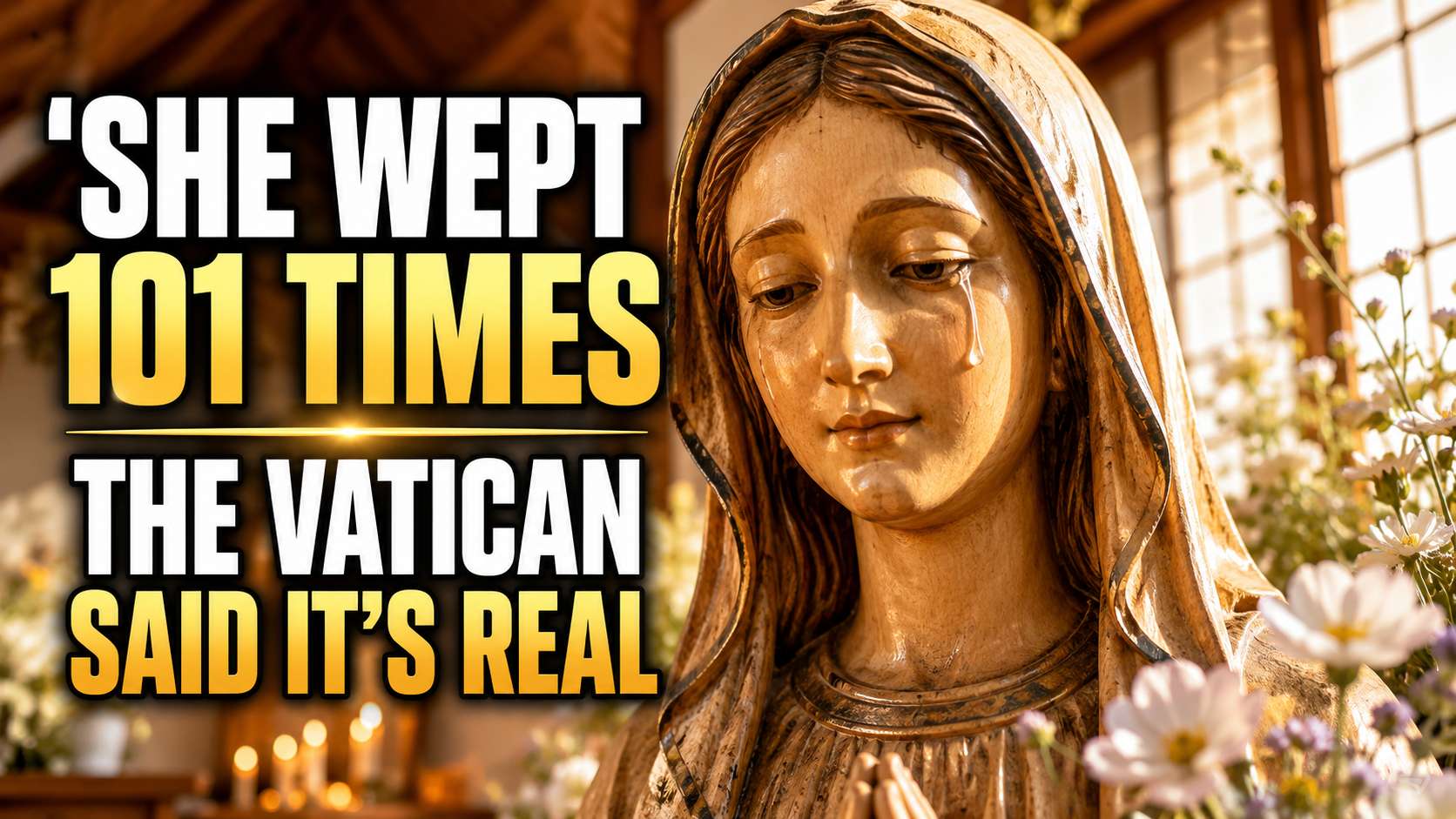
In January 1975, another extraordinary phenomenon attracted widespread attention. The wooden statue began to shed tears.
At first, only a few sisters witnessed the event. However, news gradually spread beyond the convent walls. Soon priests, pilgrims, journalists, doctors, and ordinary visitors reported seeing tears flow down the statue’s face.
Over the following years, the statue reportedly wept 101 separate times. Several events were photographed and recorded on video. Consequently, the phenomenon attracted growing public interest both within Japan and abroad.
The tears appeared naturally rather than as moisture collecting on the surface. Therefore, Church authorities arranged scientific examinations instead of relying only on eyewitness testimony.
Researchers later analyzed samples collected from the statue. Laboratory testing reportedly identified substances consistent with human tears, perspiration, and blood. Although science could describe the material itself, it could not explain why these substances repeatedly appeared on a carved wooden statue.
For Catholics, however, the scientific findings alone did not prove a miracle. Instead, the Church considered them alongside witness testimony, theological examination, and the spiritual fruits that followed.
Why the Events Captured Worldwide Attention
Several factors made Our Lady of Akita unlike many reported apparitions.
Among the most remarkable features were:
- A deaf nun who reported hearing interior locutions.
- A wooden Marian statue that reportedly wept 101 times.
- Cross-shaped wounds associated with both Sister Agnes and the statue.
- Scientific testing of the tears, blood, and perspiration.
- Years of careful investigation before any Church decision.
- A consistent message calling people to prayer, repentance, and the Rosary.
Above all, the reported messages remained firmly centered on Christ. They encouraged repentance rather than fear, conversion rather than sensationalism, and hope rather than despair. As a result, investigators focused less on extraordinary signs and more on whether the events inspired authentic Christian faith.
Church Investigation: How the Catholic Church Examined Our Lady of Akita
The Catholic Church approaches reported miracles with caution rather than excitement. Because extraordinary claims require careful discernment, Church authorities spent many years investigating Our Lady of Akita before reaching any conclusion.
Instead of relying on personal testimonies alone, investigators examined every aspect of the reported events. They interviewed witnesses, reviewed medical evidence, studied the messages, and evaluated the spiritual fruits that followed.
A Careful Investigation Lasted Fifteen Years
Bishop John Shojiro Ito, the local bishop of Niigata, directed the investigation with patience and prudence. He formed commissions that included theologians, medical professionals, and other experts. Together, they considered whether the reported events agreed with Catholic doctrine and whether any natural explanation could account for the phenomena.
Meanwhile, scientists examined samples taken from the statue. According to reports from the investigation, laboratory testing identified substances consistent with human tears, blood, and perspiration. Although science confirmed the nature of the samples, it did not determine their cause.
More importantly, the Church never based its judgment on laboratory results alone. Catholic authorities also examined the messages, the credibility of the witnesses, and the spiritual impact on those who encountered the events.
After fifteen years of study, Bishop Ito concluded that nothing in the reported apparitions contradicted Catholic teaching. In 1984, he declared the events of Our Lady of Akita worthy of belief for the faithful of his diocese.
His declaration did not create a new doctrine or add to Sacred Scripture. Instead, it recognized that Catholics could accept the apparition as a credible private revelation without contradicting their faith.
The Vatican’s Response
Many readers wonder whether Rome approved Our Lady of Akita. The answer requires an important distinction.
The Catholic Church teaches that the local bishop has the primary responsibility for investigating reported private revelations within his diocese. Therefore, Bishop Ito’s judgment carried significant authority.
Later, Cardinal Joseph Ratzinger—who became Pope Benedict XVI—reportedly affirmed that Bishop Ito’s decision regarding Akita remained valid. Although the Vatican did not issue a separate universal declaration equivalent to a dogmatic definition, it allowed the bishop’s approval to stand.
Consequently, Our Lady of Akita remains one of the few modern Marian apparitions officially recognized through the Church’s established process of discernment.
What Does the Catholic Church Teach About Private Revelation?
Understanding Our Lady of Akita begins with understanding the Church’s teaching on private revelation.
Catholics believe that God fully revealed everything necessary for salvation through Jesus Christ. Sacred Scripture and Sacred Tradition contain this complete public revelation, which concluded with the death of the last Apostle.
Therefore, no apparition can add new doctrines or replace the Gospel.
Instead, approved private revelations serve a different purpose. They remind believers to live the Gospel more faithfully in a particular time and place.
The Catechism of the Catholic Church explains that authentic private revelations do not improve or complete Christ’s definitive Revelation. Rather, they help believers live it more fully during specific periods of history.
For that reason, Catholics may freely accept approved apparitions such as Our Lady of Akita, Lourdes, or Fatima. However, belief in these apparitions is not required for salvation.
This balanced approach protects both faith and reason. It encourages devotion while preventing sensationalism.
The Message of Our Lady of Akita
Although many people first hear about the weeping statue, the Church places greater importance on the messages than on the extraordinary signs.
The reported messages given to Sister Agnes consistently pointed toward Jesus Christ. Rather than encouraging fear or curiosity, they invited people to renew their relationship with God.
Several themes appeared repeatedly.
Prayer
Prayer stood at the heart of the messages.
Mary called believers to deepen their daily conversation with God. She encouraged perseverance even during suffering, reminding the faithful that prayer changes hearts before it changes circumstances.
Today, this invitation remains just as relevant. Modern life often fills every moment with noise and distraction. Nevertheless, quiet prayer creates space for God’s grace to work within us.
The Holy Rosary
The Rosary received special emphasis throughout the reported messages.
For centuries, Catholics have prayed the Rosary while reflecting on the life, death, and Resurrection of Jesus Christ. By encouraging this devotion, Our Lady of Akita directed attention back to Christ rather than to herself.
Many families have also discovered that praying the Rosary together strengthens faith, encourages forgiveness, and builds unity.
Penance and Conversion
Another central theme involved repentance.
Rather than condemning sinners, the messages urged people to return to God through sincere conversion. This call echoes the preaching of Jesus Himself, who began His public ministry by inviting people to repent and believe the Gospel.
Consequently, Akita reminds every Christian that God’s mercy always remains available to those who seek Him with humble hearts.
A Biblical Perspective on Our Lady of Akita
Although the Bible does not mention Akita specifically, its spiritual themes reflect many biblical teachings.
The prophet Ezekiel reveals God’s loving desire for repentance. God declares that He takes no pleasure in the death of the wicked but wants them to turn from their ways and live. This message closely mirrors Akita’s call to conversion.
Likewise, the Gospel of Luke presents Mary as a woman who treasured God’s works and pondered them in her heart. Her faithful obedience at the Annunciation and her presence at the foot of the Cross reveal a mother who continually leads people toward her Son.
At the wedding feast of Cana, Mary gives one of her simplest and most enduring instructions: “Do whatever He tells you.” That brief command summarizes every authentic Marian apparition approved by the Church.
Therefore, Our Lady of Akita should never distract believers from Christ. Instead, it invites them to follow Him more faithfully through prayer, repentance, and trust.
Spiritual Lessons for Catholics Today
Whether someone accepts Our Lady of Akita or simply studies its history, several practical lessons stand out.
These lessons remain valuable for everyday Christian life:
- Pray faithfully even when God seems silent.
- Trust Christ during suffering and uncertainty.
- Make the Rosary part of your regular prayer life.
- Receive the Sacraments with greater devotion.
- Practice acts of charity and forgiveness.
- Offer personal sacrifices with love.
- Stay rooted in Scripture and Church teaching.
- Remember that holiness grows through ordinary faithfulness.
Above all, Akita reminds us that God’s love reaches ordinary people in ordinary places. He often chooses humility over grandeur and quiet faith over public recognition.
Sister Agnes never sought attention. Instead, she lived a hidden life of obedience and prayer. Her example encourages every believer to seek holiness without chasing recognition.
Furthermore, the weeping statue points beyond itself. The tears symbolize a mother’s concern for her children, while the messages direct every heart toward Jesus Christ.
For that reason, the lasting importance of Our Lady of Akita does not rest on extraordinary signs alone. It rests on a timeless invitation to return to prayer, embrace conversion, and place complete trust in God’s mercy.
Frequently Asked Questions About Our Lady of Akita
1. What is Our Lady of Akita?
Our Lady of Akita refers to the reported Marian apparitions and events that occurred in Akita, Japan, beginning in 1973. The events involved Sister Agnes Sasagawa, a Japanese nun, and a wooden statue of the Virgin Mary that reportedly shed tears 101 times between 1975 and 1981.
The Catholic Church investigated the events carefully and approved them as worthy of belief through Bishop John Shojiro Ito’s declaration in 1984.
2. Did the Catholic Church approve Our Lady of Akita?
Yes. The local bishop, Bishop John Shojiro Ito of Niigata, declared Our Lady of Akita worthy of belief after many years of investigation.
The Church examined the reported messages, witness accounts, scientific findings, and spiritual fruits. However, Catholics are not required to believe in private revelations because they do not belong to the essential deposit of faith.
3. Why did the statue of Our Lady of Akita weep?
According to witnesses, the wooden statue associated with Our Lady of Akita shed tears on 101 occasions. Scientists examined samples taken from the statue and reported that they contained human tears, blood, and perspiration.
The Church considered these findings as part of a broader investigation. The approval focused not only on the physical events but also on whether the messages remained consistent with Catholic faith and teaching.
4. What was the message of Our Lady of Akita?
The message of Our Lady of Akita focused on prayer, repentance, sacrifice, and conversion.
The reported messages encouraged Catholics to pray the Rosary, seek forgiveness, strengthen their relationship with God, and remain faithful during difficult times.
Above all, the message directed believers toward Jesus Christ and deeper trust in God’s mercy.
5. Is Our Lady of Akita connected to Fatima?
Many Catholics notice similarities between Our Lady of Akita and Fatima because both emphasize prayer, repentance, and conversion.
However, they are separate Marian apparitions that occurred in different countries and historical circumstances. The Church evaluates each reported apparition independently.
6. Does the Catholic Church consider Our Lady of Akita a miracle?
The Catholic Church recognizes the events connected with Our Lady of Akita as worthy of belief. However, private revelations do not receive the same level of certainty as official Church teachings or Sacred Scripture.
The Church encourages the faithful to view such events through the lens of the Gospel and the teachings of Christ.
7. What can Catholics learn from Our Lady of Akita today?
Catholics can learn the importance of prayer, humility, repentance, and perseverance.
The message of Our Lady of Akita reminds believers that spiritual renewal begins with personal conversion. It encourages families to pray together, trust God during suffering, and remain faithful in daily life.
8. Where can I learn more about Our Lady of Akita?
Readers can learn more by studying Catholic resources, Church documents, Scripture, and writings about approved Marian apparitions.
Reliable sources include the Vatican, bishops’ conferences, and recognized Catholic historical resources.
Conclusion: The Timeless Message of Our Lady of Akita
The story of Our Lady of Akita continues to touch hearts because it combines mystery with a simple spiritual invitation.
A quiet convent in Japan became the setting for an extraordinary series of events. A humble nun became the witness to a message centered on prayer, repentance, and trust in God.
However, the greatest lesson of Akita is not the tears of a wooden statue. The deeper message points toward a mother’s love and her desire to guide her children closer to Jesus.
Throughout history, God has often spoken through humble places and unexpected people. Therefore, the story of Akita reminds us that Heaven does not always use powerful voices. Sometimes, it speaks through silence, prayer, and a gentle call to conversion.
Today, the world faces many challenges. Families experience struggles, communities experience division, and many people search for meaning. Nevertheless, the message of Our Lady of Akita remains relevant because it directs people back to the foundations of Christian life.
Prayer changes hearts. Repentance restores relationships with God. Faith gives strength during suffering.
Most importantly, Mary always leads believers toward her Son.
As she said at Cana, “Do whatever He tells you.” This remains the heart of every authentic Marian message.
Catholic Prayer Inspired by Our Lady of Akita
Blessed Virgin Mary, Our Lady of Akita,
You called your children back to prayer and deeper faith in your Son, Jesus Christ. Help us open our hearts to God’s mercy and follow His will each day.
Teach our families to pray with sincerity. Strengthen those who suffer. Guide sinners toward repentance and fill the world with the peace of Christ.
May we trust in God’s love and remain faithful during every trial.
Our Lady of Akita, pray for us.
Amen.
Call to Action
Did the story of Our Lady of Akita inspire you?
Share your thoughts in the comments below. What is one small step you can take this week to grow closer to God?
If this article strengthened your faith, share it with someone who may need hope and encouragement.
Continue exploring more inspiring Catholic stories, Marian apparitions, saints, and miracles to deepen your journey of faith.
External Authority Sources
Recommended trustworthy references:
- Vatican City
- Information about Catholic teaching and Church documents.
- Catechism of the Catholic Church
- Teaching on revelation, faith, and Christian life.
- United States Conference of Catholic Bishops
- Catholic resources and explanations of doctrine.
- New Advent Catholic Encyclopedia
- Historical Catholic reference material.
Related Articles
 Hidden Christians of Japan: Faith That Survived 250 Years
 How to Pray the Rosary Step-by-Step (Complete Catholic Guide)
 Incorrupt Saints: The Catholic Church’s Teaching Explained
 Battle of Lepanto and the Rosary: The Story of 1571
 Catholic Church Miracle Investigation Process Explained
 How the Blessed Virgin Mary Teaches Us to Trust God Completely