Have you ever wondered whether Our Lady of Las Lajas could truly be an image formed in solid rock without any artist painting it?
For more than 250 years, pilgrims have traveled deep into the Andes Mountains of southern Colombia to pray before a mysterious image embedded in a canyon wall. Many visitors ask the same question: How did this image appear, and why has it remained one of the most beloved Marian shrines in Latin America?
In this article, you will discover the historical origins of Our Lady of Las Lajas, what tradition says happened in 1754, what the Catholic Church officially teaches, and why this story continues to inspire millions of Christians today.
The Historical Background of Our Lady of Las Lajas
To understand Our Lady of Las Lajas, we must begin in the rugged mountains near the modern city of Ipiales in southern Colombia, close to the border with Ecuador.
The sanctuary stands inside a dramatic canyon carved by the Guáitara River. Steep cliffs rise on both sides, while mist often drifts through the valley below. Long before a church existed there, local people used the narrow canyon as a travel route through the mountains.
The name “Las Lajas” comes from the flat layers of sedimentary rock that form the canyon walls. According to local tradition, these stone formations became the setting for one of the most famous Marian stories in South America.
Today, the sanctuary of Our Lady of Las Lajas attracts millions of visitors each year. Colombia’s tourism authorities also recognize it as one of the country’s most important religious and architectural landmarks.
What Happened in 1754?
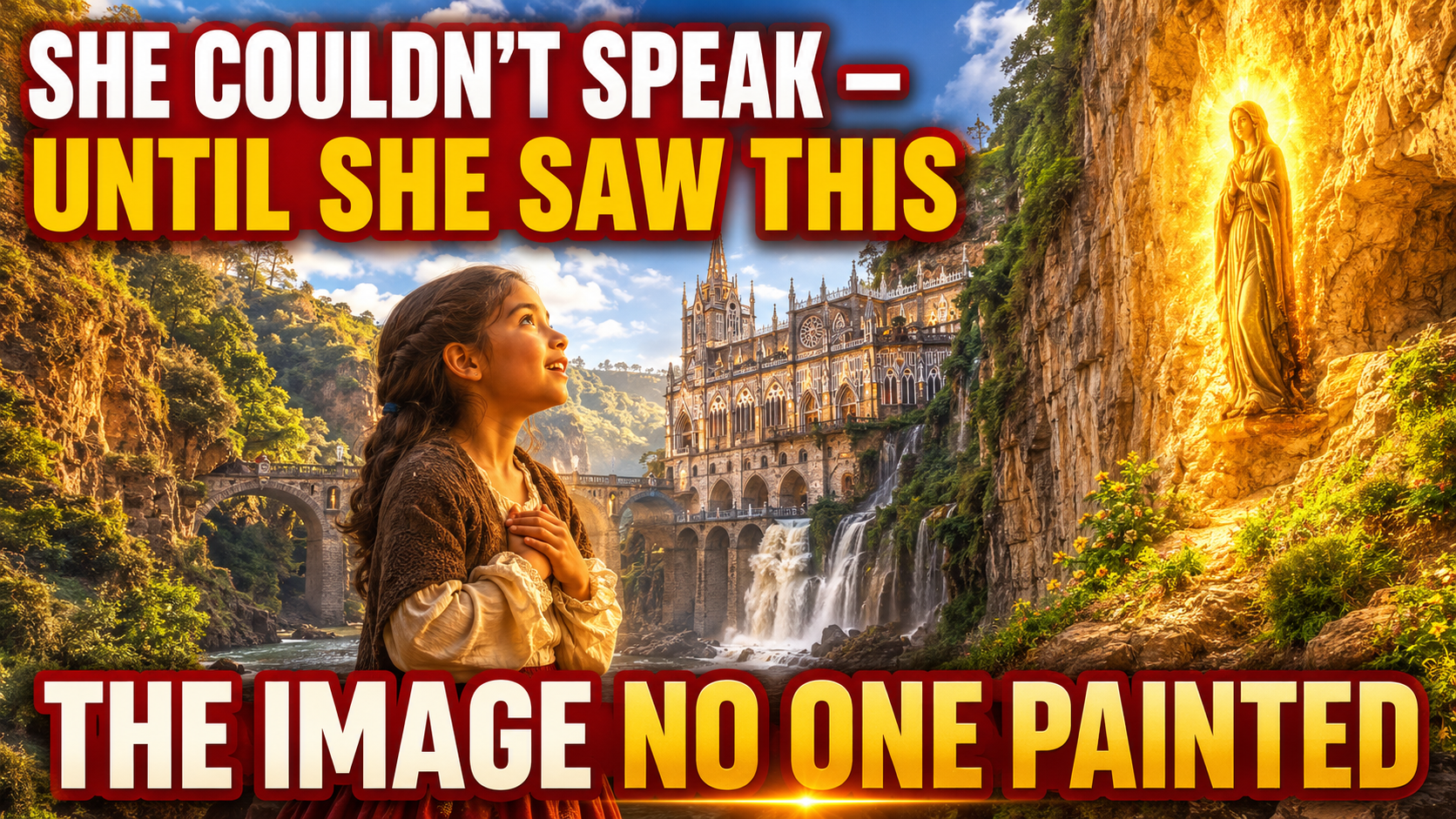
According to the traditional account, a woman named María Mueces traveled through the canyon in 1754 with her young daughter Rosa.
Rosa had reportedly been deaf and unable to speak since birth. During their journey, a violent storm suddenly swept through the mountains. Strong winds and heavy rain forced María to search for shelter among the rocks.
As they waited beside the cliff, Rosa became unusually excited. She pointed toward the stone wall and, according to the tradition, spoke for the first time in her life. She told her mother that she saw a beautiful woman standing on the rock.
Naturally, María struggled to understand what had happened. However, the story did not end there.
Rosa’s Second Encounter
A few days later, Rosa disappeared near the same canyon. María searched desperately for her daughter and eventually found her sitting peacefully beside a woman dressed in radiant clothing.
When María returned with other people, the woman had vanished. Yet those present claimed that an image had begun to appear on the rock where the mysterious visitor had stood.
Because news spread quickly through the region, many people soon came to see the cliff for themselves.
The Image Embedded in Stone
The most remarkable feature of Our Lady of Las Lajas is the image itself.
Visitors do not see a canvas attached to the wall. Instead, the image appears within the surface of the rock. It depicts:
- The Virgin Mary holding the Child Jesus.
- Saint Dominic kneeling on one side.
- Saint Francis kneeling on the other side.
- A radiant crown-like light surrounding Mary.
Researchers have examined the stone for generations. Although experts continue debating exactly how the coloration formed, the image remains integrated into the rock rather than existing as a separate painted layer.
Consequently, pilgrims view the image as extraordinary even apart from the original apparition story.
How the Great Sanctuary Was Built
As devotion to Our Lady of Las Lajas grew, local Catholics constructed small chapels near the image. Over time, those structures proved too small for the increasing number of pilgrims.
The current sanctuary was built between 1916 and 1949 in a dramatic Gothic Revival style.
What Makes the Church Unique?
The church seems to emerge directly from the canyon walls. A large bridge connects the sanctuary to the opposite side of the gorge, while the river flows far below.
Some of its most striking features include:
- A stone bridge spanning the canyon.
- Tall Gothic towers.
- Stained-glass windows.
- A sanctuary built around the original rock image.
- Hundreds of steps used by pilgrims for prayer and penance.
Because of this unusual setting, many travelers consider it one of the most beautiful churches in the world.
What Does the Catholic Church Officially Teach?
This is an important question.
The Catholic Church does not require Catholics to believe that the apparition of Our Lady of Las Lajas occurred exactly as tradition describes. Apparitions belong to the category of private revelation, not public revelation.
Public Revelation vs. Private Revelation
The Church teaches that:
- Public Revelation ended with Jesus Christ and the Apostles.
- Private revelations may help believers live the Gospel more fully.
- No Catholic must accept a private revelation as a condition of salvation.
The Catechism of the Catholic Church explains that approved private revelations cannot add new doctrines to the faith.
What Has the Church Approved?
Although belief in the apparition remains optional, the Church has officially recognized the devotion associated with the shrine.
Church authorities have:
- Approved the sanctuary as a place of Catholic pilgrimage.
- Allowed public devotion there.
- Granted the image a canonical coronation, a special honor given to significant Marian images.
Therefore, Catholics may confidently visit Our Lady of Las Lajas for prayer and devotion while remembering that such devotion always points toward Christ.
The Biblical Meaning of Marian Devotion
Some readers may wonder whether honoring Mary distracts from Jesus.
In fact, the story of Our Lady of Las Lajas reflects a biblical pattern: Mary continually directs people toward her Son.
“All Generations Will Call Me Blessed”
In Luke 1:48, Mary says:
“All generations will call me blessed.”
Catholics honor Mary because God chose her to bear Jesus Christ, not because she possesses power apart from Him.
“Do Whatever He Tells You”
At the wedding at Cana, Mary’s only recorded instruction is found in John 2:5:
“Do whatever he tells you.”
This verse summarizes authentic Marian devotion. Mary leads believers to obey Christ.
“Behold Your Mother”
While dying on the cross, Jesus said to the beloved disciple:
“Behold your mother.” (John 19:27)
The Church sees this passage as part of Mary’s spiritual motherhood of believers.
Thus, the message associated with Our Lady of Las Lajas fits the broader biblical understanding of Mary as a guide to Christ.
Spiritual Lessons from Our Lady of Las Lajas
Even people who remain uncertain about the historical details can still learn important spiritual lessons from this story.
1. God Notices the Forgotten
The tradition begins with a poor woman and a disabled child, not with powerful leaders. Throughout Scripture, God often chooses humble people to reveal His grace.
2. Hard Hearts Can Change
The image appears on cold, solid rock. Many pilgrims see this as a symbol of God’s ability to soften hardened hearts.
3. Hope Can Grow in Difficult Places
The sanctuary rises from a dark canyon where storms once threatened travelers. Likewise, God often brings hope from places that seem hopeless.
Practical ways to apply these lessons:
- Pray for someone who feels isolated.
- Visit a local Marian shrine.
- Read the Gospel accounts of Mary.
- Ask Jesus to heal areas of spiritual “silence” in your life.
Frequently Asked Questions About Our Lady of Las Lajas
Is Our Lady of Las Lajas a real Catholic shrine?
Yes. The Catholic Church officially recognizes the sanctuary as a legitimate place of pilgrimage and devotion.
Did the Church declare the apparition unquestionably true?
No. The Church approved the devotion but does not require Catholics to believe every detail of the apparition story.
Where is Our Lady of Las Lajas located?
The shrine is located near Ipiales, Nariño, Colombia, close to the Ecuadorian border.
Is the image painted on the rock?
The image appears integrated into the rock surface rather than existing as a separate canvas attached to the wall.
Why do pilgrims visit Our Lady of Las Lajas?
Pilgrims visit to pray, attend Mass, seek spiritual comfort, and honor the Virgin Mary.
What does “canonical coronation” mean?
A canonical coronation is an official recognition by the Church that a Marian image has long inspired widespread devotion.
Can non-Catholics visit the sanctuary?
Yes. Many tourists, historians, architects, and Christians from other traditions visit the shrine.
Why Our Lady of Las Lajas Still Inspires Millions
More than two centuries after the original story, Our Lady of Las Lajas continues to attract pilgrims from around the world.
People come for different reasons:
- Faith.
- Curiosity.
- Architecture.
- History.
- Personal prayer.
Yet many visitors leave with the same impression: the sanctuary combines natural beauty and spiritual reflection in a remarkable way.
Whether one focuses on the mysterious image, the dramatic canyon, or the Gospel message of hope, Our Lady of Las Lajas reminds us that God often works in unexpected places.
A Prayer to Our Lady of Las Lajas
Our Lady of Las Lajas, you brought comfort to the forgotten and hope to those who suffered. Pray for us when our hearts grow hard and our faith becomes weak. Lead us always to your Son, Jesus Christ, and help us trust Him in every storm. Amen.
Continue Exploring Catholic Miracles and History
If this story of Our Lady of Las Lajas inspired you, consider sharing it with someone who needs encouragement.
You may also enjoy reading about:
- The Holy House of Loreto.
- Our Lady of Guadalupe.
- The Miracle of Lanciano.
- The Hidden Christians of Japan.
- The incorrupt saints.
- How the Vatican investigates miracles.
- The story of Padre Pio.
- The Shrine of Lourdes.
Leave a comment below and tell us: Which Catholic miracle or saint’s story should we explore next?
Trusted Sources for Further Reading
- Vatican
- United States Conference of Catholic Bishops (USCCB)
- Vatican News
- Catholic Encyclopedia (New Advent)
- Catechism of the Catholic Church
Related Articles
 Our Lady of Akita: The Approved Marian Apparition
 Holy House of Loreto: The Mystery of Mary’s Home
 Catholic Church Miracle Investigation Process Explained
 How to Pray the Rosary Step-by-Step (Complete Catholic Guide)
 Incorrupt Saints: The Catholic Church’s Teaching Explained
 Battle of Lepanto and the Rosary: The Story of 1571