Introduction
What happened when 70,000 people gathered in a muddy field in Portugal to witness a promised sign? The story of Our Lady of Fatima begins with three ordinary shepherd children and leads to one of the most discussed Marian events in modern Catholic history.
On October 13, 1917, thousands gathered near Fatima. They came from different backgrounds and held very different opinions. Some believed the children’s claims. Others arrived as skeptics. Journalists also attended, including some who had mocked the reports.
According to eyewitness accounts, an extraordinary solar phenomenon followed. The event became known as the Miracle of the Sun.
Yet the story of Our Lady of Fatima involves more than an unusual event in the sky. It centers on prayer, conversion, sacrifice, and trust in God. Moreover, it raises an important question: Why would God choose three young shepherd children to deliver such a serious message?
To understand Fatima, we must first return to the humble children who started it all.
Our Lady of Fatima and the Three Shepherd Children
In 1917, Europe suffered through the devastation of the First World War. Meanwhile, three children lived a simple life in rural Portugal.
Lucia dos Santos was ten years old. Her cousins, Francisco Marto and Jacinta Marto, were nine and seven.
The children often tended sheep in the countryside near Fatima. Nothing about their daily lives suggested that they would soon become central figures in Catholic history.
However, everything changed on May 13, 1917.
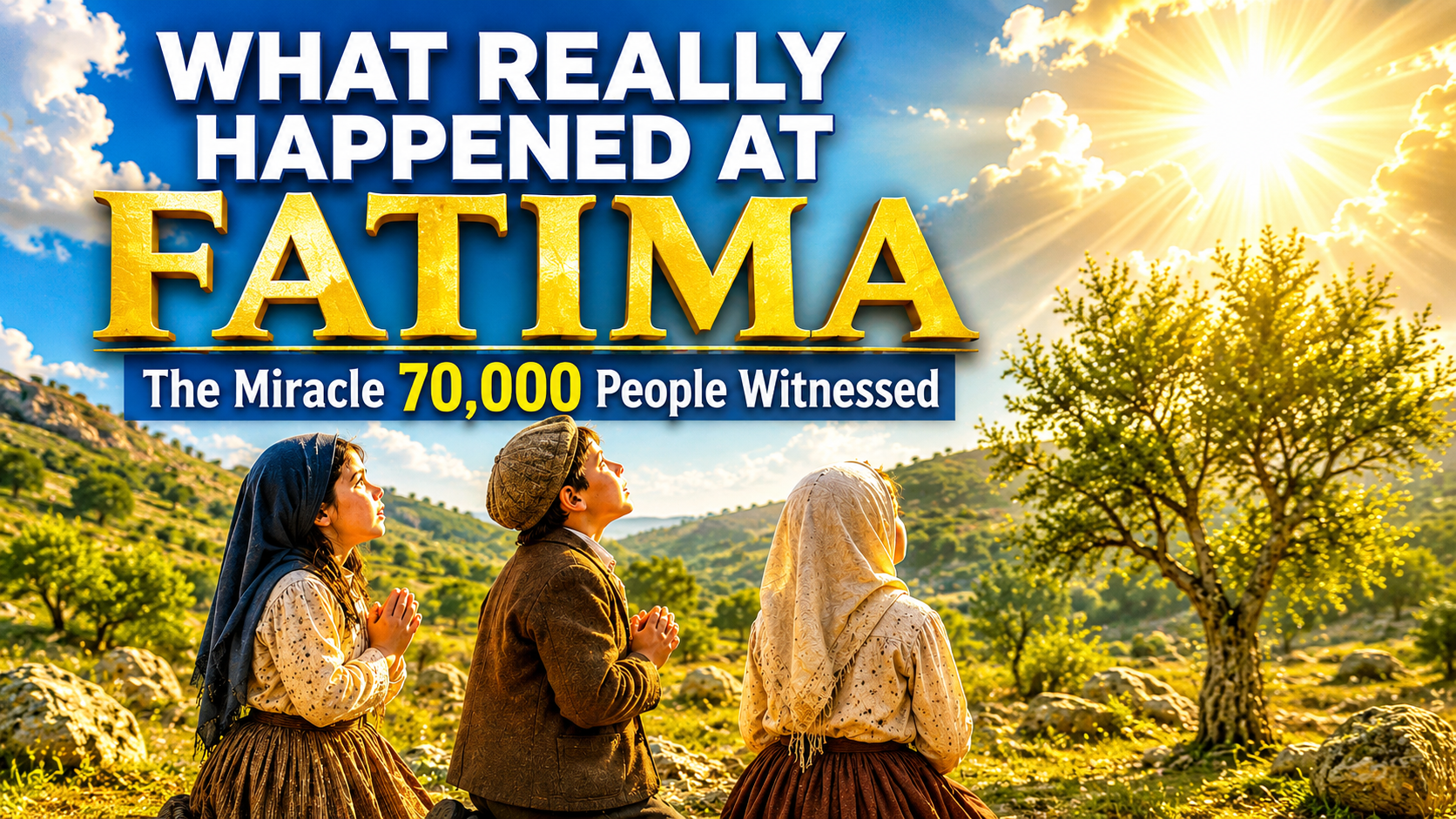
According to their testimony, the children saw a woman who appeared brighter than the sun. She stood above a small holm oak tree and identified herself as coming from heaven. The children later reported that she asked them to return to the same place on the thirteenth day of each month.
The children continued to report these experiences over the following months. As news spread, curiosity grew. So did opposition.
Some people mocked the children. Others questioned their honesty. Local authorities even interrogated them. At one point, officials attempted to pressure them into revealing what they had been told.
Despite these challenges, the children maintained their testimony.
Their story never changed in its central message. Instead, they continued to speak about prayer, conversion, sacrifice, and the need to turn back to God.
The Message of Our Lady of Fatima
The central message associated with Our Lady of Fatima was remarkably simple.
The children reported a call to:
- Pray the Rosary every day.
- Make sacrifices for sinners.
- Turn away from sin.
- Seek conversion.
- Pray for peace.
- Trust God during times of suffering.
This message arrived during one of the darkest periods in modern European history.
The First World War had already caused enormous suffering. Families had lost loved ones, nations had experienced destruction, and millions faced uncertainty.
Therefore, the call to prayer and conversion carried a powerful meaning.
Rather than offering a message focused on curiosity or spectacle, Fatima directed people toward Christian living.
The emphasis remained spiritual. The message encouraged people to pray more faithfully and to examine their lives before God.
In addition, the Rosary held a central place in the message connected with Fatima. Catholics have long used the Rosary to meditate on the life, death, and Resurrection of Jesus Christ through the mysteries of the Gospel.
For that reason, the Fatima message continues to resonate with Catholics who seek a deeper prayer life.
What Happened on October 13, 1917?
The most famous event connected with Our Lady of Fatima occurred on October 13, 1917.
The children had announced that something extraordinary would happen on that date. As a result, a large crowd gathered near the site of the reported apparitions.
Estimates commonly place the crowd at around 70,000 people, although historical estimates vary.
Rain had turned the area into a muddy field. Nevertheless, people continued to wait.
They came because they believed the children. Others came because they wanted to challenge the claims. Some arrived simply out of curiosity.
Then, according to many eyewitness reports, an unusual solar phenomenon appeared.
Witnesses described the sun as appearing to spin, change colors, or move dramatically in the sky. Some said it seemed to move toward the earth before appearing to return to its normal position.
The event became known as the Miracle of the Sun.
What Did Witnesses Actually See?
The reports differ in their details.
Some witnesses described bright colors. Others reported unusual movements. Not everyone interpreted the event in exactly the same way.
Importantly, historians and scientists have proposed different explanations. These include optical effects caused by staring toward the sun, atmospheric conditions, and psychological factors.
However, no single natural explanation has convinced everyone who has studied the historical accounts.
Some reports also came from people who were not standing directly among the main crowd. That detail has contributed to continuing discussion about the event.
Even so, Catholics should approach the subject with care.
The Church does not require Catholics to accept the Miracle of the Sun as a matter of faith. Nor does the Church require Catholics to believe every private revelation.
Instead, the Church evaluates alleged apparitions carefully.
What Does the Catholic Church Teach About Our Lady of Fatima?
The Catholic Church distinguishes between public revelation and private revelation.
Public revelation refers to God’s definitive revelation through Jesus Christ. The Church teaches that this revelation ended with the apostolic age. Catholics must believe what God has revealed through Christ and what the Church faithfully teaches.
Private revelations have a different role.
According to the Catechism of the Catholic Church, private revelations do not belong to the deposit of faith. Even when the Church recognizes a private revelation, Catholics do not have to treat it as another article of faith.
Instead, such revelations may help people live the Gospel more deeply during a particular period.
That principle applies to Our Lady of Fatima.
After a long process of investigation, Church authorities recognized the Fatima apparitions as worthy of belief. The Diocese of Leiria-Fatima officially recognized the supernatural character of the events in 1930.
Therefore, Catholics may practice devotion connected with Fatima. However, they must always keep the devotion centered on Christ and the Gospel.
The Church also looks at the spiritual fruits associated with an apparition.
In Fatima’s case, the message encouraged:
- Prayer.
- Conversion.
- Repentance.
- Sacrifice.
- Devotion to the Rosary.
- Trust in God’s mercy.
- Concern for the salvation of others.
These themes remain deeply consistent with Catholic spirituality.
Why Did God Choose Three Children?
The story of Our Lady of Fatima also reflects a pattern found throughout Scripture.
God often works through people whom the world considers weak or insignificant.
For example, God chose David, a young shepherd, to become king of Israel. He also chose Mary, a young woman from Nazareth, to become the Mother of Jesus.
Saint Paul explains this divine pattern in his First Letter to the Corinthians. He writes that God chooses what the world considers foolish or weak to reveal His wisdom and power.
The lesson does not mean that God values ignorance or weakness for their own sake.
Instead, Scripture shows that God looks at the heart.
The three Fatima children did not possess political influence. They did not have wealth or social status. They were ordinary children who lived simple lives.
Yet they responded to what they believed God was asking of them.
That response offers an important spiritual lesson.
God does not always begin His work through people who appear powerful. Instead, He often begins with humility, trust, and willingness.
The Spiritual Lessons of Our Lady of Fatima
The message of Our Lady of Fatima remains relevant because its central themes do not belong only to 1917.
Today, Catholics still face fear, anxiety, conflict, suffering, and uncertainty. Therefore, the call to prayer and conversion remains meaningful.
1. Make Prayer Part of Daily Life
The Fatima message strongly emphasized prayer, especially the Rosary.
However, you do not need to begin with an hour of prayer each day.
Instead, start with something simple.
You could pray:
- One decade of the Rosary.
- A short prayer before work.
- A few minutes of silence before God.
- A Scripture passage each morning.
- A prayer for someone who is suffering.
Small acts of faith can become lasting habits.
2. Offer Your Suffering to God
Fatima also emphasized sacrifice.
This does not mean seeking suffering or harming yourself. Rather, Catholics can offer ordinary difficulties to God with love.
For example, you might patiently accept an inconvenience. You might forgive someone who hurt you. You might give up a small comfort and use that moment to pray.
In this way, daily sacrifices can become acts of love.
3. Pray for Others
The children were encouraged to pray for sinners.
This reminds Christians that prayer should not focus only on personal needs.
Instead, we can pray for:
- Our families.
- The sick.
- Those who have lost hope.
- People far from God.
- Victims of war and violence.
- Those who have died.
- People who have never encountered the Gospel.
Consequently, prayer becomes an act of charity.
4. Remain Faithful During Difficult Times
The children faced ridicule and pressure.
Nevertheless, they continued to hold to their testimony.
Their example reminds Christians that faithfulness does not always produce immediate results. Sometimes, we must remain patient when others misunderstand us.
Christian perseverance often begins with small acts of courage.
Francisco, Jacinta, and Lucia: Three Different Paths
The story of Our Lady of Fatima also reminds us that each person’s vocation can look different.
Francisco Marto died in 1919 at the age of ten after becoming seriously ill during the influenza pandemic.
His sister, Jacinta Marto, died in 1920 at the age of nine.
Both children remained remembered for their devotion and prayer.
Lucia dos Santos lived much longer. She eventually became a Carmelite nun and lived until the age of 97.
Although their lives followed different paths, all three became closely associated with the Fatima message.
The Church later recognized Francisco and Jacinta as saints. Pope Francis canonized them in Fatima on May 13, 2017, during the centenary celebrations of the apparitions.
Their story therefore extends far beyond the events of 1917.
What Our Lady of Fatima Can Teach Families Today
Families can also draw practical lessons from Fatima.
Parents can introduce children to prayer without making prayer feel like a burden.
For example, families can:
- Pray one decade of the Rosary together.
- Read a short Gospel passage.
- Pray for someone who needs help.
- Attend Sunday Mass faithfully.
- Practice small acts of sacrifice.
- Teach children to trust God during difficult moments.
Moreover, families can use Fatima as an opportunity to discuss the difference between authentic faith and sensationalism.
The goal is not to chase extraordinary experiences.
Instead, the goal is to grow closer to Jesus Christ.
That point remains essential. The heart of Catholic devotion always leads back to Christ.
Frequently Asked Questions About Our Lady of Fatima
1. Who is Our Lady of Fatima?
Our Lady of Fatima refers to the title associated with the Marian apparitions reported by three shepherd children in Fatima, Portugal, in 1917.
2. What is the main message of Our Lady of Fatima?
The message of Our Lady of Fatima emphasizes prayer, conversion, repentance, sacrifice, and the daily praying of the Rosary.
3. What happened during the Miracle of the Sun?
On October 13, 1917, many witnesses reported an unusual solar phenomenon near Fatima. The event became known as the Miracle of the Sun.
4. Does every Catholic have to believe in Our Lady of Fatima?
No. Catholics are not required to believe in private revelations such as Fatima. The Church approved the apparitions as worthy of belief, but they do not form part of the essential deposit of faith.
5. Who were the three children of Fatima?
The three children were Lucia dos Santos and her cousins, Francisco Marto and Jacinta Marto.
6. Why is the Rosary important in the Fatima message?
The Rosary holds a central place in the Fatima message because it directs Christians toward meditation on the life of Jesus Christ and encourages daily prayer.
7. What can Catholics learn from Our Lady of Fatima today?
Catholics can learn to pray consistently, seek conversion, offer difficulties to God, pray for others, and remain faithful during times of uncertainty.
8. Where can I learn more about Our Lady of Fatima?
Readers can consult official Catholic sources, including the Vatican, the Diocese of Leiria-Fatima, the Catechism of the Catholic Church, and reliable Catholic historical resources.
Conclusion: The Message of Our Lady of Fatima Still Speaks Today
The story of Our Lady of Fatima began with three children in a Portuguese countryside.
It continued through months of questioning, ridicule, and uncertainty. Then, on October 13, 1917, thousands gathered to witness what many believed was a miraculous sign.
Yet the deeper message reaches beyond the Miracle of the Sun.
Fatima calls Christians back to something simple: prayer, conversion, sacrifice, and trust in God.
You do not need to see a miracle in the sky to begin.
Instead, you can begin today.
Pray one decade of the Rosary. Spend five quiet minutes with God. Offer one difficulty with patience. Forgive someone. Pray for a person who has lost hope.
Ultimately, the story of Our Lady of Fatima reminds us that God can work through ordinary people who remain humble, faithful, and willing to listen.
As Jesus teaches in Matthew 5:16, our lives should point others toward the glory of our heavenly Father.
The real challenge, therefore, is not simply to remember what happened in 1917.
It is to ask what God asks of us today.
A Short Prayer Inspired by Fatima
Lord Jesus,
give me the humble heart of a child.
Teach me to pray with faith and trust.
Help me offer my daily struggles with love.
Give me courage to turn away from sin
and strength to remain faithful when life becomes difficult.
Bless my family and those who need Your mercy.
Through the prayers of the Blessed Virgin Mary,
lead me always closer to Your Sacred Heart.
May my life become a small offering of love
for You and for others.
Amen.
Call to Action
Has the story of Our Lady of Fatima inspired you to deepen your prayer life?
Leave a comment and share one small way you plan to pray differently this week.
If this article helped you understand the Fatima story more deeply, share it with a friend or family member who may find encouragement in its message.
You can also subscribe to our Catholic content for more stories about the saints, Marian apparitions, miracles, Scripture, and the deeper meaning of the Catholic faith.
The Vatican — Official documents and information about the Catholic Church and Marian devotion.Catechism of the Catholic Church — Especially the sections concerning public and private revelation.Diocese of Leiria-Fatima — Official information regarding the Fatima sanctuary and the history of the apparitions.Vatican News — Catholic news and historical coverage related to Fatima and its centenary.New Advent Catholic Encyclopedia — Historical and theological reference material for Catholic topics.
Related Articles
 Holy House of Loreto: The Mystery of Mary’s Home
 How to Pray the Rosary Step-by-Step (Complete Catholic Guide)
 What Happens When You Die? Catholic Teaching
 Saint Jude Prayer for Impossible Situations
 This 1,200-Year-Old Miracle Science STILL Can’t Explain (The Lanciano Eucharistic Miracle)
 Our Lady of Akita: The Approved Marian Apparition